Pearson+ LogoPearson+ Logo
Ch. 3 - Cell Structure and Function
Bauman - Microbiology with Diseases by Taxonomy 6th Edition
Bauman6th EditionMicrobiology with Diseases by TaxonomyISBN: 9780134832302Not the one you use?Change textbook
Chapter 3, Problem 8

Contrast a cell of Streptococcus pyogenes (a bacterium) with the unicellular protozoan Entamoeba histolytica, listing at least eight differences.

Verified step by step guidance
1
Identify the basic classification of each organism: Streptococcus pyogenes is a bacterium (prokaryote), while Entamoeba histolytica is a unicellular protozoan (eukaryote).
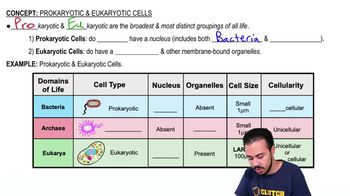
Compare cell structure: note that Streptococcus pyogenes lacks a true nucleus and membrane-bound organelles, whereas Entamoeba histolytica has a defined nucleus and organelles such as mitochondria.
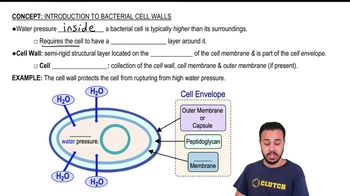
Examine cell wall composition: Streptococcus pyogenes has a thick peptidoglycan cell wall characteristic of Gram-positive bacteria, while Entamoeba histolytica lacks a cell wall and instead has a flexible plasma membrane.
Discuss size differences: typically, Entamoeba histolytica cells are larger than bacterial cells like Streptococcus pyogenes.
Look at modes of locomotion: Entamoeba histolytica moves using pseudopodia, whereas Streptococcus pyogenes is non-motile.
Consider reproduction methods: Streptococcus pyogenes reproduces asexually by binary fission, while Entamoeba histolytica reproduces by mitotic division and can form cysts for survival.
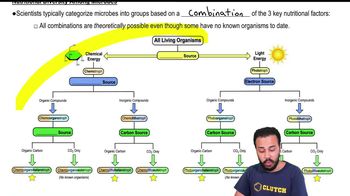
Analyze metabolic capabilities: Streptococcus pyogenes is generally a facultative anaerobe relying on fermentation, whereas Entamoeba histolytica is anaerobic and obtains energy through phagocytosis and fermentation.
Evaluate genetic material organization: Streptococcus pyogenes has a single circular chromosome and may have plasmids, while Entamoeba histolytica has multiple linear chromosomes within a nucleus.

Verified video answer for a similar problem:

This video solution was recommended by our tutors as helpful for the problem above.
Video duration:
3m
Was this helpful?

Key Concepts

Here are the essential concepts you must grasp in order to answer the question correctly.

Cellular Structure Differences between Prokaryotes and Eukaryotes

Streptococcus pyogenes is a prokaryotic bacterium lacking a nucleus and membrane-bound organelles, while Entamoeba histolytica is a eukaryotic protozoan with a defined nucleus and organelles like mitochondria. This fundamental difference affects their complexity and cellular processes.
Recommended video:
Guided course
05:54
Prokaryotic & Eukaryotic Cells

Cell Wall Composition

S. pyogenes has a rigid cell wall made of peptidoglycan, providing shape and protection, characteristic of bacteria. In contrast, E. histolytica lacks a cell wall and instead has a flexible plasma membrane, allowing for shape changes and movement.
Recommended video:
Guided course
03:44
Introduction to Bacterial Cell Walls

Mode of Nutrition and Locomotion

S. pyogenes obtains nutrients through absorption and is non-motile, relying on passive movement. E. histolytica is heterotrophic, ingesting food particles via phagocytosis, and moves actively using pseudopodia, which are extensions of its cytoplasm.
Recommended video:
Guided course
05:58
Nutritional Diversity Among Microbes