Ch. 4 - Microscopy, Staining, and Classification
Bauman - Microbiology with Diseases by Taxonomy 6th Edition
Bauman6th EditionMicrobiology with Diseases by TaxonomyISBN: 9780134832302Not the one you use?Change textbook
Chapter 4, Problem 3

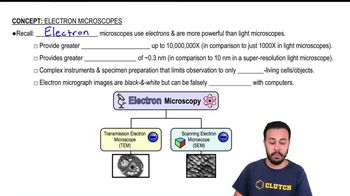
Why can electron microscopes magnify only dead organisms?

Verified step by step guidance
1
Understand that electron microscopes use a beam of electrons instead of light to create an image, which requires a vacuum environment to prevent electrons from scattering.
Recognize that living organisms contain water and other volatile substances that would evaporate or be damaged in the vacuum, making it impossible to observe them alive under an electron microscope.
Know that the preparation process for electron microscopy involves fixing, dehydrating, and sometimes coating the specimen with a conductive material, all of which kill the organism.
Realize that these preparation steps are necessary to preserve fine structural details and to allow electrons to pass through or reflect off the specimen effectively.
Conclude that because of the vacuum requirement and the harsh preparation methods, electron microscopes can only magnify dead organisms.

Verified video answer for a similar problem:

This video solution was recommended by our tutors as helpful for the problem above.
Video duration:
2m
Was this helpful?

Key Concepts

Here are the essential concepts you must grasp in order to answer the question correctly.

Electron Microscopy Principles

Electron microscopes use beams of electrons instead of light to achieve much higher resolution and magnification. Because electrons have much shorter wavelengths than visible light, they can reveal fine structural details at the nanometer scale, which is essential for studying cellular ultrastructure.
Recommended video:
Guided course
03:08
Electron Microscopes

Sample Preparation and Vacuum Requirement

Electron microscopes require samples to be placed in a high vacuum to prevent electron scattering by air molecules. Living organisms cannot survive in this vacuum environment, so samples must be fixed, dehydrated, and often coated with conductive materials, which kills the cells.
Recommended video:
Guided course
03:52
Oxygen Requirements for Microbial Growth

Impact of Electron Beam on Biological Samples

The high-energy electron beam used in electron microscopy can damage or destroy living cells by breaking chemical bonds and generating heat. This makes it impossible to observe live organisms directly, limiting electron microscopy to dead, preserved specimens.
Recommended video:
Guided course
04:23
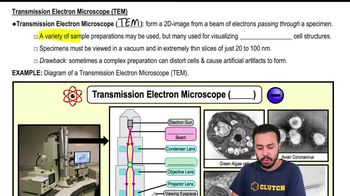
Transmission Electron Microscope (TEM)