Correct the following incorrect names: a. 2,4,6-tribromobenzene
Verified step by step guidance
1
Step 1: Identify the structure of the compound based on the given name. If the name is incorrect, determine the possible structural features that might have been intended.
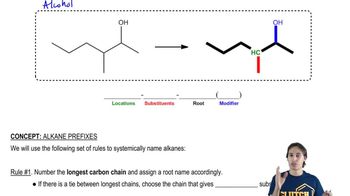
Step 2: Apply the IUPAC (International Union of Pure and Applied Chemistry) naming rules to the compound. These rules include identifying the longest continuous carbon chain, assigning the correct parent name, and numbering the chain to give substituents the lowest possible numbers.
Step 3: Check for functional groups, substituents, and stereochemistry. Ensure that all substituents are named correctly and listed in alphabetical order, and that stereochemical descriptors (e.g., R/S or E/Z) are included if applicable.
Step 4: Verify that the corrected name is unambiguous and follows all IUPAC conventions. Cross-check the corrected name with the structure to ensure consistency.
Step 5: Write the corrected name clearly and concisely, ensuring that it accurately represents the structure of the compound.
Verified video answer for a similar problem:
This video solution was recommended by our tutors as helpful for the problem above
Video duration:
3m
Play a video:
Was this helpful?
Key Concepts
Here are the essential concepts you must grasp in order to answer the question correctly.
IUPAC Nomenclature
IUPAC nomenclature is a systematic method for naming organic chemical compounds. It provides rules for naming based on the structure of the molecule, including the longest carbon chain, functional groups, and substituents. Understanding these rules is essential for correctly identifying and naming compounds, which is crucial for effective communication in chemistry.
Functional groups are specific groups of atoms within molecules that are responsible for the characteristic chemical reactions of those molecules. Common functional groups include hydroxyl (-OH), carboxyl (-COOH), and amino (-NH2) groups. Recognizing functional groups is vital for understanding the properties and reactivity of organic compounds, as they dictate how a compound behaves in chemical reactions.
Isomerism refers to the phenomenon where two or more compounds have the same molecular formula but different structures or arrangements of atoms. This can lead to different physical and chemical properties. Understanding isomerism is important for correctly naming compounds, as structural isomers and stereoisomers can have distinct names and implications in organic chemistry.