Solve each problem. See Example 1. The perimeter of a triangular plot of land is 2400 ft.The longest side is 200 ft less than twice the shortest. The middle side is 200 ft less than the longest side. Find the lengths of the three sides of the triangular plot.
Table of contents
- 0. Review of Algebra4h 18m
- 1. Equations & Inequalities3h 18m
- 2. Graphs of Equations1h 43m
- 3. Functions2h 17m
- 4. Polynomial Functions1h 44m
- 5. Rational Functions1h 23m
- 6. Exponential & Logarithmic Functions2h 28m
- 7. Systems of Equations & Matrices4h 5m
- 8. Conic Sections2h 23m
- 9. Sequences, Series, & Induction1h 22m
- 10. Combinatorics & Probability1h 45m
1. Equations & Inequalities
Linear Equations
Problem 43
Textbook Question
Solve each problem. See Examples 5 and 6. Formaldehyde is an indoor air pollutant formerly found in plywood, foam insulation, and carpeting. When concentrations in the air reach 33 micrograms per cubic foot (μg/ft^3), eye irritation can occur. One square foot of new plywood could emit 140 μg per hr. (Data from A. Hines, Indoor Air Quality & Control.) A room has 100 ft^2 of new plywood flooring. Find a linear equation F that computes the amount of formaldehyde, in micrograms, emitted in x hours.
Verified step by step guidance1
Identify the given information: each square foot of plywood emits 140 micrograms of formaldehyde per hour, and the room has 100 square feet of plywood.
Calculate the total emission rate for the entire 100 square feet by multiplying the emission rate per square foot by the total area: \$140 \times 100$ micrograms per hour.
Define the variable \(x\) as the number of hours elapsed.
Write the linear equation \(F(x)\) to represent the total amount of formaldehyde emitted after \(x\) hours by multiplying the total emission rate by \(x\): \(F(x) = (140 \times 100) \times x\).
Simplify the equation if desired to express \(F(x)\) in terms of \(x\).
Verified video answer for a similar problem:This video solution was recommended by our tutors as helpful for the problem above
Video duration:
2mPlay a video:
Was this helpful?
Key Concepts
Here are the essential concepts you must grasp in order to answer the question correctly.
Linear Equations
A linear equation represents a relationship where one variable changes at a constant rate with respect to another. It is typically written in the form y = mx + b, where m is the slope and b is the y-intercept. In this problem, the amount of formaldehyde emitted changes linearly with time, making a linear equation suitable to model the situation.
Recommended video:
Categorizing Linear Equations
Rate of Change (Slope)
The rate of change indicates how much one quantity changes relative to another. Here, the rate is the amount of formaldehyde emitted per hour per square foot of plywood. Understanding this rate allows you to calculate total emissions over time by multiplying the rate by the number of hours and the total area.
Recommended video:
Guided course
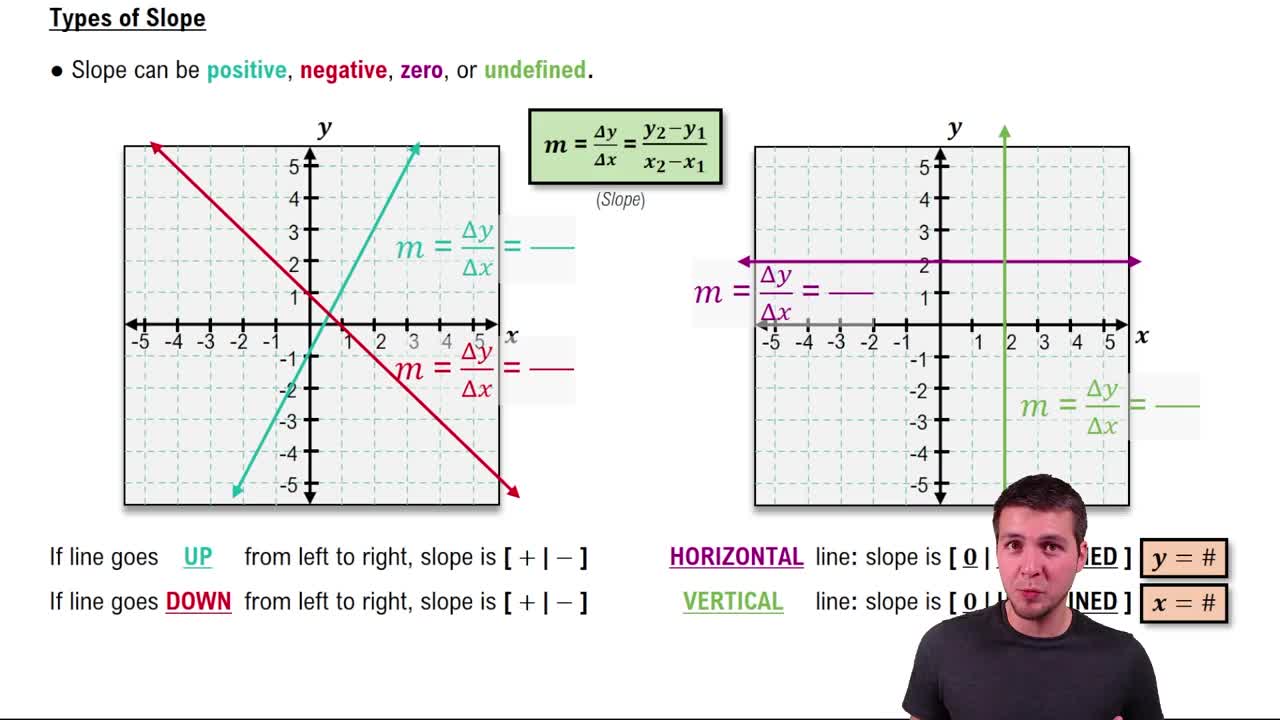
Types of Slope
Unit Conversion and Multiplication
Properly handling units is essential to ensure the equation's accuracy. Since emission is given per square foot per hour, multiplying by the total square footage and time in hours yields the total micrograms emitted. This step combines the rate with the total area and time to form the linear equation.
Recommended video:
Square Roots of Negative Numbers
Watch next
Master Introduction to Solving Linear Equtions with a bite sized video explanation from Patrick
Start learningRelated Videos
Related Practice
Textbook Question
471
views