Table of contents
- 0. Review of Algebra4h 18m
- 1. Equations & Inequalities3h 18m
- 2. Graphs of Equations1h 43m
- 3. Functions2h 17m
- 4. Polynomial Functions1h 44m
- 5. Rational Functions1h 23m
- 6. Exponential & Logarithmic Functions2h 28m
- 7. Systems of Equations & Matrices4h 5m
- 8. Conic Sections2h 23m
- 9. Sequences, Series, & Induction1h 22m
- 10. Combinatorics & Probability1h 45m
1. Equations & Inequalities
Linear Equations
Problem 20
Textbook Question
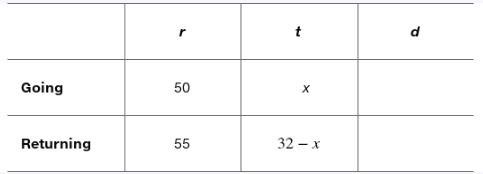
Solve each problem. See Example 2. Elwyn averaged 50 mph traveling from Denver to Minneapolis. Returning by a different route that covered the same number of miles, he averaged 55 mph. What is the distance between the two cities to the nearest ten miles if his total traveling time was 32 hr?
Verified step by step guidance1
Let the distance between Denver and Minneapolis be \(d\) miles. Since the return trip covers the same distance, the total distance traveled is \$2d$ miles.
Express the time taken for each leg of the trip using the formula \(\text{time} = \frac{\text{distance}}{\text{speed}}\). For the trip to Minneapolis, the time is \(\frac{d}{50}\) hours, and for the return trip, the time is \(\frac{d}{55}\) hours.
Write an equation for the total travel time by adding the two times together and setting it equal to 32 hours: \(\frac{d}{50} + \frac{d}{55} = 32\).
Find a common denominator for the fractions on the left side, combine them into a single fraction, and then solve the resulting equation for \(d\).
Once you have the value of \(d\), round it to the nearest ten miles to find the distance between the two cities.
Verified video answer for a similar problem:This video solution was recommended by our tutors as helpful for the problem above
Video duration:
5mPlay a video:
Was this helpful?
Key Concepts
Here are the essential concepts you must grasp in order to answer the question correctly.
Average Speed and Distance Relationship
Average speed is defined as the total distance traveled divided by the total time taken. In problems involving travel, the formula distance = speed × time is fundamental to relate these quantities and solve for unknowns.
Recommended video:
Foci and Vertices of an Ellipse
Setting Up Equations with Multiple Variables
When a problem involves different speeds and times for the same distance, it requires setting up equations with variables representing unknown quantities. Using the given conditions, these equations can be combined and solved simultaneously.
Recommended video:
Guided course
Equations with Two Variables
Solving Quadratic Equations
Problems involving total time and different speeds often lead to quadratic equations when expressing time in terms of distance. Understanding how to rearrange, factor, or use the quadratic formula is essential to find the correct distance.
Recommended video:
Solving Quadratic Equations by Factoring
Watch next
Master Introduction to Solving Linear Equtions with a bite sized video explanation from Patrick
Start learningRelated Videos
Related Practice
Textbook Question
Solve each problem. Which one or more of the following cannot be a correct equation to solve a geometry problem, if x represents the length of a rectangle? (Hint: Solve each equation and consider the solution.) A. 2x+2(x- ) = 14 B. -2x+7(5-x) = 52 C. 5(x+2)+5x = 10 D. 2x+2(x-3) = 22
393
views