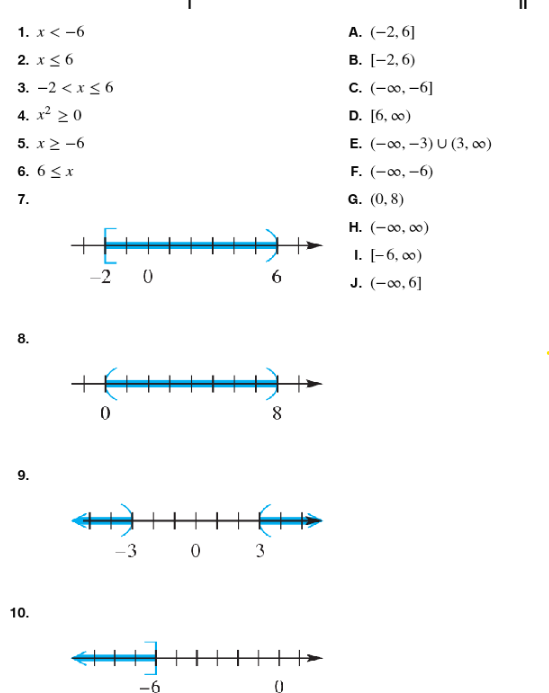
Match the inequality in each exercise in Column I with its equiva-lent interval notation in Column II. x^2≥0
Verified step by step guidance
1
Step 1: Recognize that the inequality \( x^2 \geq 0 \) is asking for all values of \( x \) where the square of \( x \) is greater than or equal to zero.
Step 2: Understand that any real number squared is always non-negative, meaning \( x^2 \geq 0 \) is true for all real numbers.
Step 3: Conclude that the solution set for \( x^2 \geq 0 \) includes all real numbers.
Step 4: Express the solution set in interval notation. Since all real numbers satisfy the inequality, the interval is \((-\infty, \infty)\).
Step 5: Match this interval notation with the corresponding option in Column II.
Verified video answer for a similar problem:
This video solution was recommended by our tutors as helpful for the problem above
Video duration:
1m
Play a video:
Was this helpful?
Key Concepts
Here are the essential concepts you must grasp in order to answer the question correctly.
Inequalities
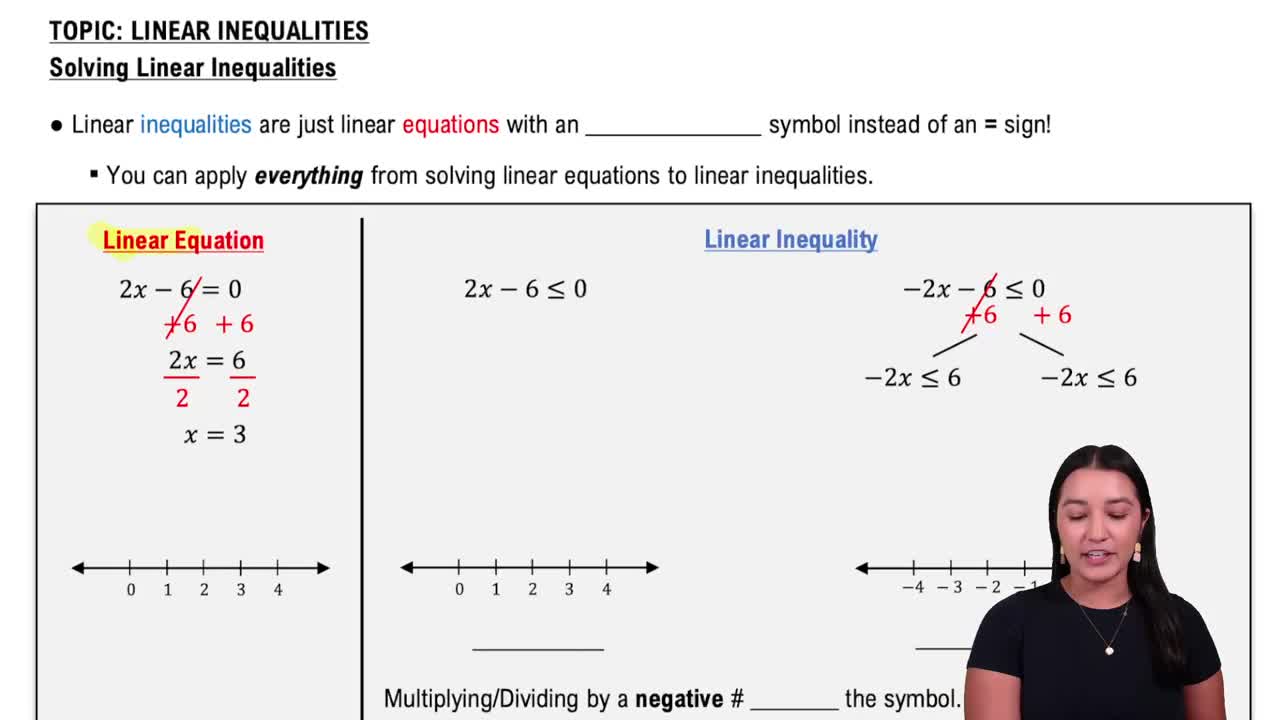
Inequalities express a relationship between two expressions that are not necessarily equal. In this case, the inequality x^2 ≥ 0 indicates that the square of x is greater than or equal to zero. Understanding how to manipulate and interpret inequalities is crucial for solving problems that involve ranges of values.
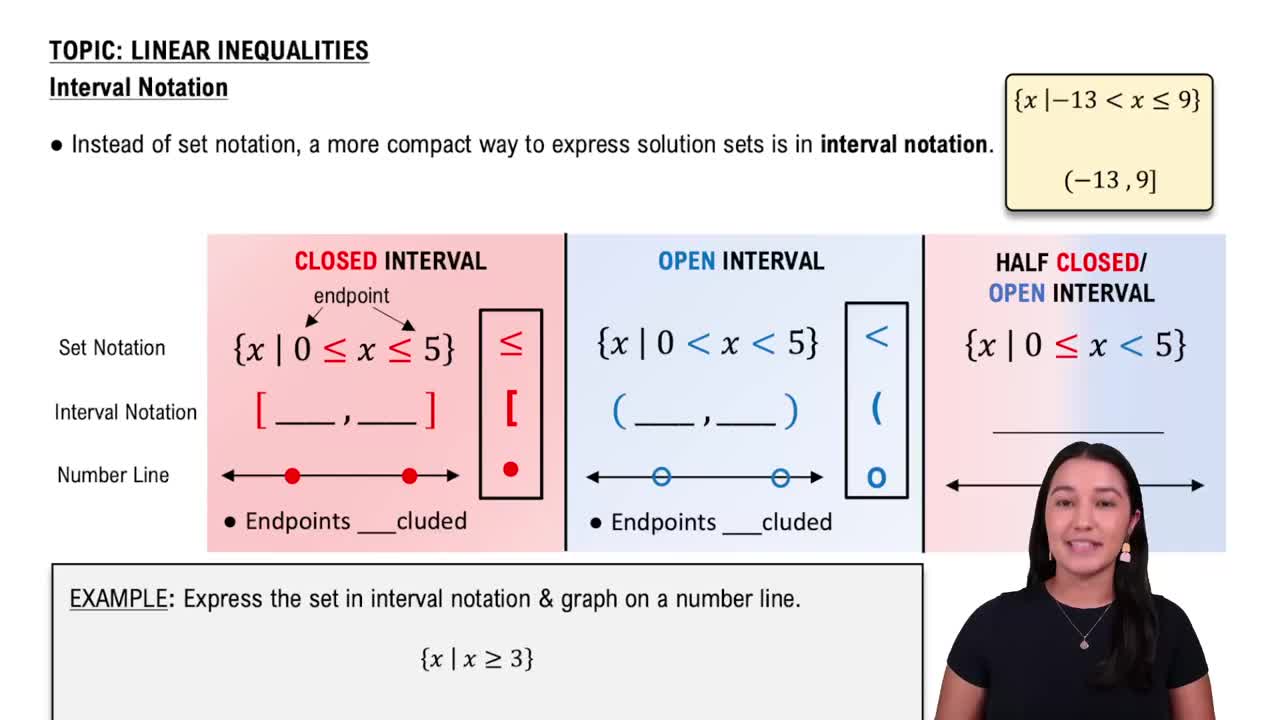
Interval notation is a mathematical notation used to represent a set of numbers between two endpoints. It uses brackets [ ] to include endpoints and parentheses ( ) to exclude them. For the inequality x^2 ≥ 0, the equivalent interval notation would be (-∞, ∞), as all real numbers satisfy this condition.
Quadratic functions are polynomial functions of degree two, typically expressed in the form f(x) = ax^2 + bx + c. The graph of a quadratic function is a parabola, and its properties, such as the vertex and axis of symmetry, help in analyzing inequalities like x^2 ≥ 0. Since the square of any real number is non-negative, this function is always above or on the x-axis.