In Exercises 15–26, use graphs to find each set. [3, ∞) ∩ (6, ∞)
Verified step by step guidance
1
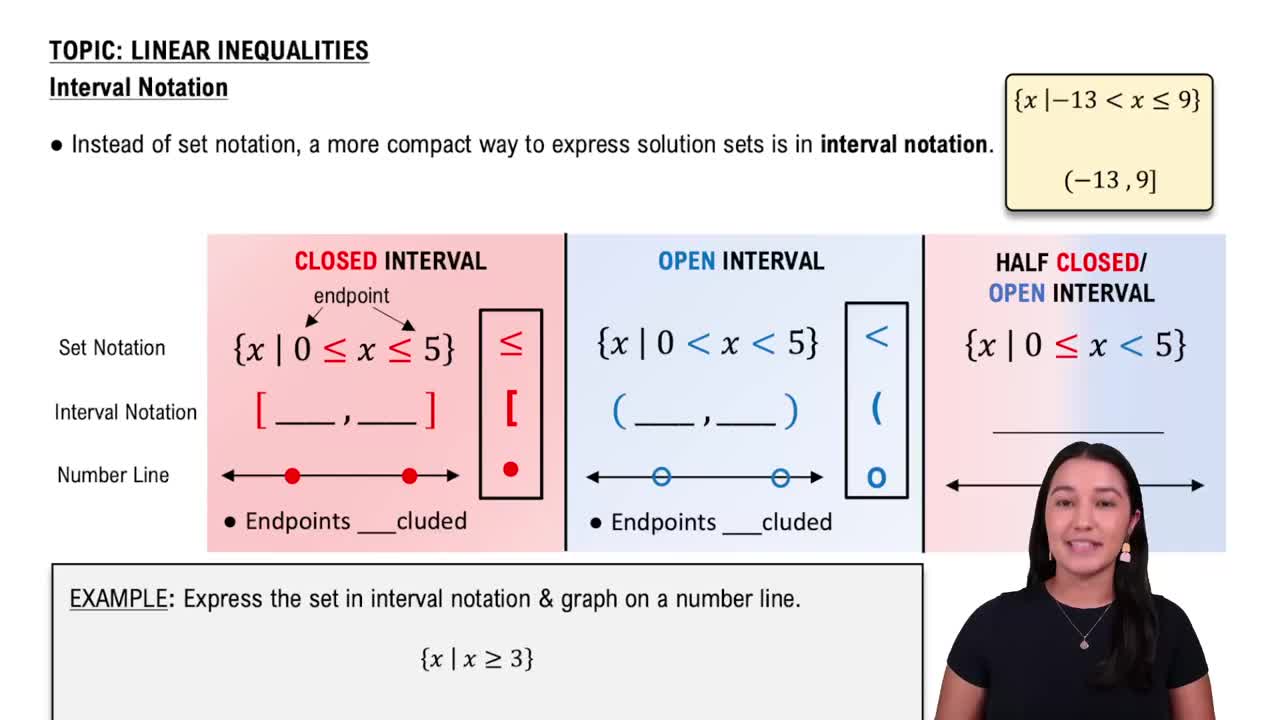
Identify the two sets given: \([3, \infty)\) and \((6, \infty)\). The first set includes all numbers from 3 to infinity, including 3, and the second set includes all numbers greater than 6, but not including 6.
Visualize each set on a number line: For \([3, \infty)\), shade the line starting at 3 (including 3) and extending to the right indefinitely. For \((6, \infty)\), shade the line starting just after 6 (not including 6) and extending to the right indefinitely.
To find the intersection \([3, \infty) \cap (6, \infty)\), look for the region where both shaded areas overlap on the number line.
Since \((6, \infty)\) starts after 6 and \([3, \infty)\) starts at 3, the overlap will be all numbers greater than 6 (because the second set is more restrictive).
Express the intersection set in interval notation, which will be the set of all numbers greater than 6, not including 6, extending to infinity.
Verified video answer for a similar problem:
This video solution was recommended by our tutors as helpful for the problem above
Video duration:
3m
Play a video:
Was this helpful?
Key Concepts
Here are the essential concepts you must grasp in order to answer the question correctly.
Interval Notation
Interval notation is a way to represent sets of real numbers using brackets and parentheses. Square brackets [ ] include endpoints, while parentheses ( ) exclude them. For example, [3, ∞) includes all numbers from 3 to infinity, including 3.
The intersection of two sets includes all elements common to both sets. For intervals, this means finding the overlapping region on the number line where both intervals exist simultaneously.
Graphing intervals involves shading the portion of the number line that corresponds to the interval. This visual helps identify overlaps and intersections by showing where intervals coincide.