In Exercises 15–26, use graphs to find each set. [3, ∞) ⋃ (6, ∞)
Verified step by step guidance
1
Understand the problem: You are asked to find the union of two intervals, \([3, \infty)\) and \((6, \infty)\), using graphs. The union means all values that belong to either interval or both.
Graph the first interval \([3, \infty)\) on a number line. This includes all numbers starting at 3 (including 3) and extending to positive infinity. Represent this with a solid dot at 3 and a ray extending to the right.
Graph the second interval \((6, \infty)\) on the same number line. This includes all numbers greater than 6 but not including 6. Represent this with an open dot at 6 and a ray extending to the right.
Identify the union of these two intervals on the graph. Since \([3, \infty)\) already includes all numbers from 3 onwards, and \((6, \infty)\) is a subset of that starting from 6, the union will cover all numbers starting at 3 and going to infinity.
Write the union interval notation based on the graph: it will be \([3, \infty)\) because this interval already contains all elements of both sets.
Verified video answer for a similar problem:
This video solution was recommended by our tutors as helpful for the problem above
Video duration:
3m
Play a video:
Was this helpful?
Key Concepts
Here are the essential concepts you must grasp in order to answer the question correctly.
Interval Notation
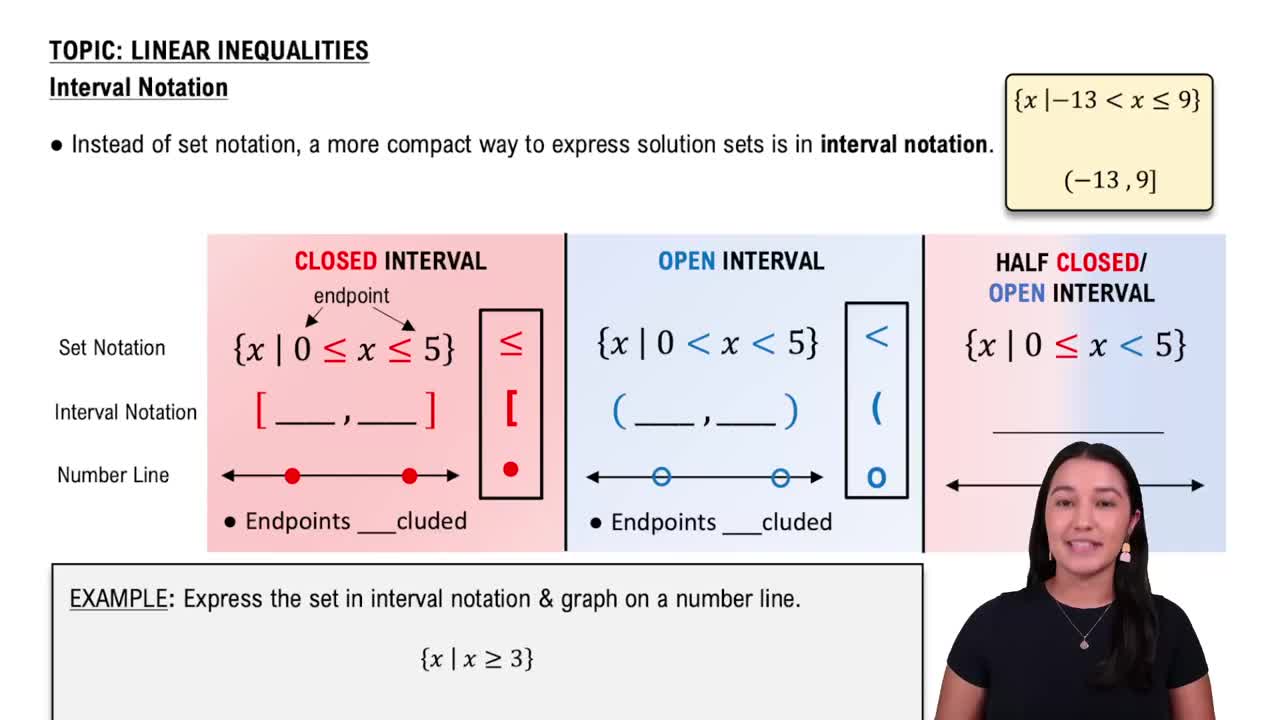
Interval notation is a way to represent sets of real numbers using brackets and parentheses. Square brackets [ ] include the endpoint, while parentheses ( ) exclude it. For example, [3, ∞) includes all numbers from 3 to infinity, including 3.
The union of two sets combines all elements from both sets without duplication. In interval notation, the union symbol (∪) merges intervals, so [3, ∞) ∪ (6, ∞) includes all numbers from 3 onwards, considering overlaps.
Graphing intervals involves shading regions on a number line to represent sets of numbers. Closed dots indicate included endpoints, open dots indicate excluded endpoints, and shading shows all numbers within the interval, helping visualize unions and intersections.