Determine whether each relation is a funciton, Give the domain and range for each relation. (1, 10), (2, 500), (13, π)
Table of contents
- 0. Review of Algebra4h 18m
- 1. Equations & Inequalities3h 18m
- 2. Graphs of Equations1h 43m
- 3. Functions2h 17m
- 4. Polynomial Functions1h 44m
- 5. Rational Functions1h 23m
- 6. Exponential & Logarithmic Functions2h 28m
- 7. Systems of Equations & Matrices4h 5m
- 8. Conic Sections2h 23m
- 9. Sequences, Series, & Induction1h 22m
- 10. Combinatorics & Probability1h 45m
2. Graphs of Equations
Graphs and Coordinates
Problem 10
Textbook Question
Evaluate each function at the given values of the independent variable and simplify. (a) f(-2), (b) f(1), (c) f(2)
Verified step by step guidance1
Step 1: Understand the problem. You are given a function f(x) and need to evaluate it at specific values of the independent variable x: -2, 1, and 2. This means substituting these values into the function and simplifying the resulting expressions.
Step 2: Substitute x = -2 into the function f(x). Replace every occurrence of x in the function with -2, and simplify the resulting expression.
Step 3: Substitute x = 1 into the function f(x). Replace every occurrence of x in the function with 1, and simplify the resulting expression.
Step 4: Substitute x = 2 into the function f(x). Replace every occurrence of x in the function with 2, and simplify the resulting expression.
Step 5: Write down the simplified results for f(-2), f(1), and f(2). These are the evaluated values of the function at the given points.
Verified video answer for a similar problem:This video solution was recommended by our tutors as helpful for the problem above
Video duration:
1mPlay a video:
Was this helpful?
Key Concepts
Here are the essential concepts you must grasp in order to answer the question correctly.
Function Evaluation
Function evaluation involves substituting a specific value for the independent variable in a function. For example, if f(x) = x^2, evaluating f(2) means calculating 2^2, which equals 4. This process is fundamental in understanding how functions behave at different points.
Recommended video:
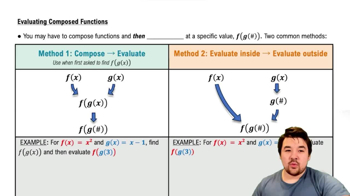
Evaluating Composed Functions
Independent Variable
The independent variable is the input of a function, typically represented by 'x' in mathematical expressions. It is the variable that you can control or change, and its value determines the output of the function. In the question, -2, 1, and 2 are the values of the independent variable for which the function is evaluated.
Recommended video:
Probability of Multiple Independent Events
Simplification
Simplification is the process of reducing an expression to its simplest form. This may involve combining like terms, factoring, or reducing fractions. After evaluating the function at the specified values, simplifying the results ensures clarity and conciseness in the final answer.
Recommended video:
Guided course
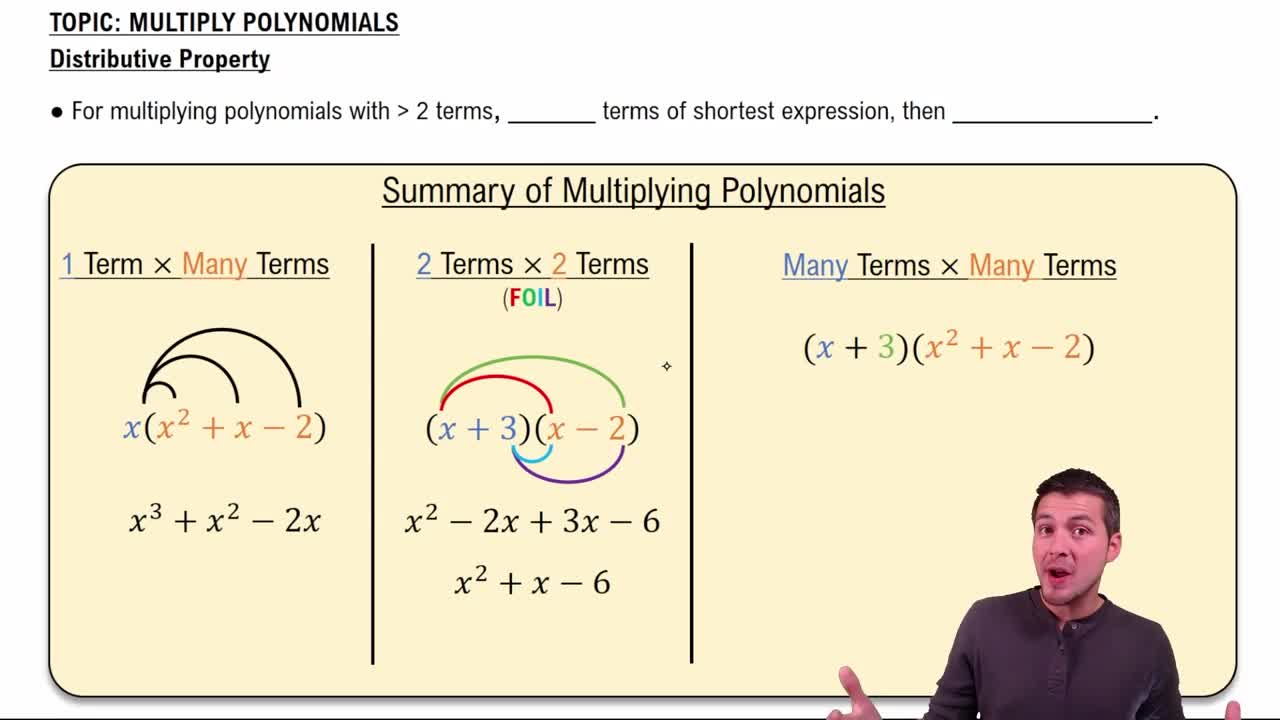
Multiply Polynomials Using the Distributive Property
Watch next
Master Graphs & the Rectangular Coordinate System with a bite sized video explanation from Patrick
Start learningRelated Videos
Related Practice
Textbook Question
67
views