Determine whether each equation defines y as a function of x. 2x + y = 8
Table of contents
- 0. Review of Algebra4h 18m
- 1. Equations & Inequalities3h 18m
- 2. Graphs of Equations1h 43m
- 3. Functions2h 17m
- 4. Polynomial Functions1h 44m
- 5. Rational Functions1h 23m
- 6. Exponential & Logarithmic Functions2h 28m
- 7. Systems of Equations & Matrices4h 5m
- 8. Conic Sections2h 23m
- 9. Sequences, Series, & Induction1h 22m
- 10. Combinatorics & Probability1h 45m
2. Graphs of Equations
Graphs and Coordinates
Problem 23
Textbook Question
Determine whether the graph of each equation is symmetric with respect to the y-axis, the x-axis, the origin, more than one of those, or none of these. x^2 + y^2 =17
Verified step by step guidance1
To determine symmetry with respect to the y-axis, replace x with -x in the equation. Substitute -x for x in the equation x^2 + y^2 = 17, resulting in (-x)^2 + y^2 = 17. Simplify the expression to check if it matches the original equation.
To determine symmetry with respect to the x-axis, replace y with -y in the equation. Substitute -y for y in the equation x^2 + y^2 = 17, resulting in x^2 + (-y)^2 = 17. Simplify the expression to check if it matches the original equation.
To determine symmetry with respect to the origin, replace both x with -x and y with -y in the equation. Substitute -x for x and -y for y in the equation x^2 + y^2 = 17, resulting in (-x)^2 + (-y)^2 = 17. Simplify the expression to check if it matches the original equation.
After performing the substitutions and simplifications for each type of symmetry, compare the resulting equations to the original equation x^2 + y^2 = 17. If the resulting equation matches the original, the graph is symmetric with respect to that axis or the origin.
Based on the results of the comparisons, conclude whether the graph is symmetric with respect to the y-axis, the x-axis, the origin, more than one of these, or none of these.
Verified video answer for a similar problem:This video solution was recommended by our tutors as helpful for the problem above
Video duration:
1mPlay a video:
Was this helpful?
Key Concepts
Here are the essential concepts you must grasp in order to answer the question correctly.
Symmetry in Graphs
Symmetry in graphs refers to the property where a graph remains unchanged under certain transformations. For example, a graph is symmetric with respect to the y-axis if replacing x with -x in the equation yields the same equation. Similarly, it is symmetric with respect to the x-axis if replacing y with -y results in the same equation, and it is symmetric with respect to the origin if replacing both x and y with their negatives preserves the equation.
Recommended video:
Guided course
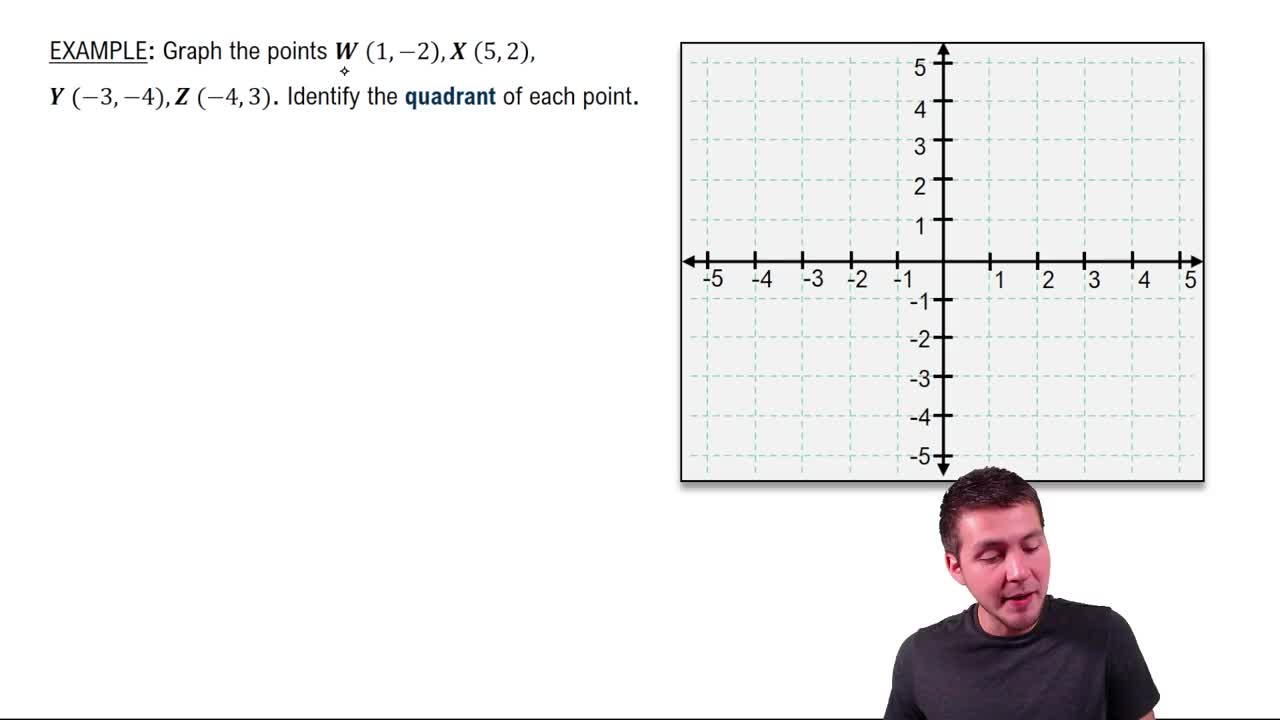
Graphs and Coordinates - Example
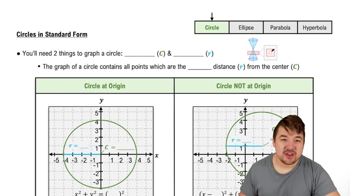
Circle Equation
The equation x^2 + y^2 = r^2 represents a circle centered at the origin with radius r. In this case, the equation x^2 + y^2 = 17 describes a circle with a radius of √17. Understanding the standard form of a circle's equation is crucial for analyzing its symmetry properties, as circles inherently exhibit symmetry about both axes and the origin.
Recommended video:
Circles in Standard Form
Testing for Symmetry
To determine the symmetry of a graph, specific tests can be applied. For y-axis symmetry, substitute -x into the equation; for x-axis symmetry, substitute -y; and for origin symmetry, substitute both -x and -y. If the resulting equation remains unchanged for any of these substitutions, the graph exhibits that type of symmetry. This methodical approach is essential for analyzing the given equation.
Recommended video:
Properties of Parabolas
Watch next
Master Graphs & the Rectangular Coordinate System with a bite sized video explanation from Patrick
Start learningRelated Videos
Related Practice
Textbook Question
1180
views