In Exercises 19–24, write an equation in slope-intercept form of a linear function f whose graph satisfies the given conditions. The graph of ƒ passes through (−6, 4) and is perpendicular to the line that has an x intercept of 2 and a y-intercept of -4.
Verified step by step guidance
1
Identify the slope of the line with x-intercept 2 and y-intercept -4. Use the formula for slope: \( m = \frac{y_2 - y_1}{x_2 - x_1} \).
Calculate the slope of the line using the points (2, 0) and (0, -4).
Determine the slope of the line perpendicular to the given line. Remember, perpendicular slopes are negative reciprocals.
Use the point-slope form of a line equation, \( y - y_1 = m(x - x_1) \), with the point (-6, 4) and the perpendicular slope.
Convert the equation from point-slope form to slope-intercept form, \( y = mx + b \).
Verified video answer for a similar problem:
This video solution was recommended by our tutors as helpful for the problem above
Video duration:
2m
Play a video:
Was this helpful?
Key Concepts
Here are the essential concepts you must grasp in order to answer the question correctly.
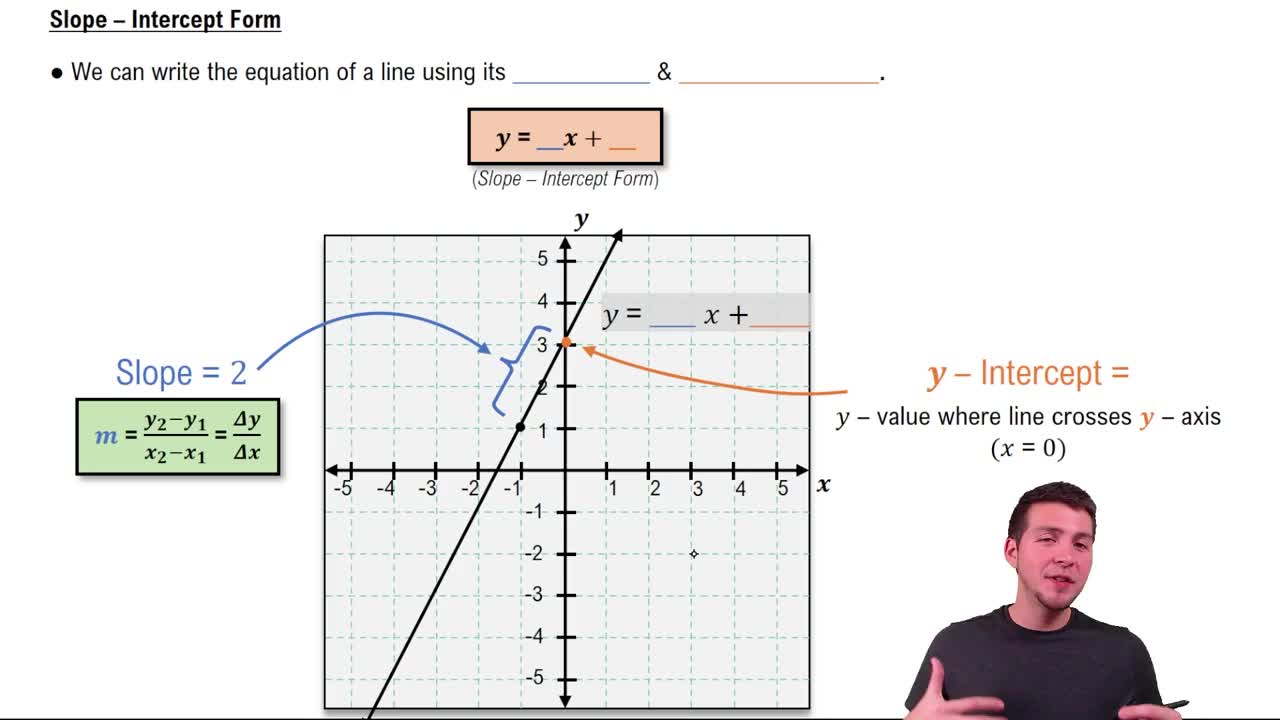
Slope-Intercept Form
The slope-intercept form of a linear equation is expressed as y = mx + b, where m represents the slope of the line and b is the y-intercept. This form is useful for quickly identifying the slope and y-intercept of a line, making it easier to graph and analyze linear functions.
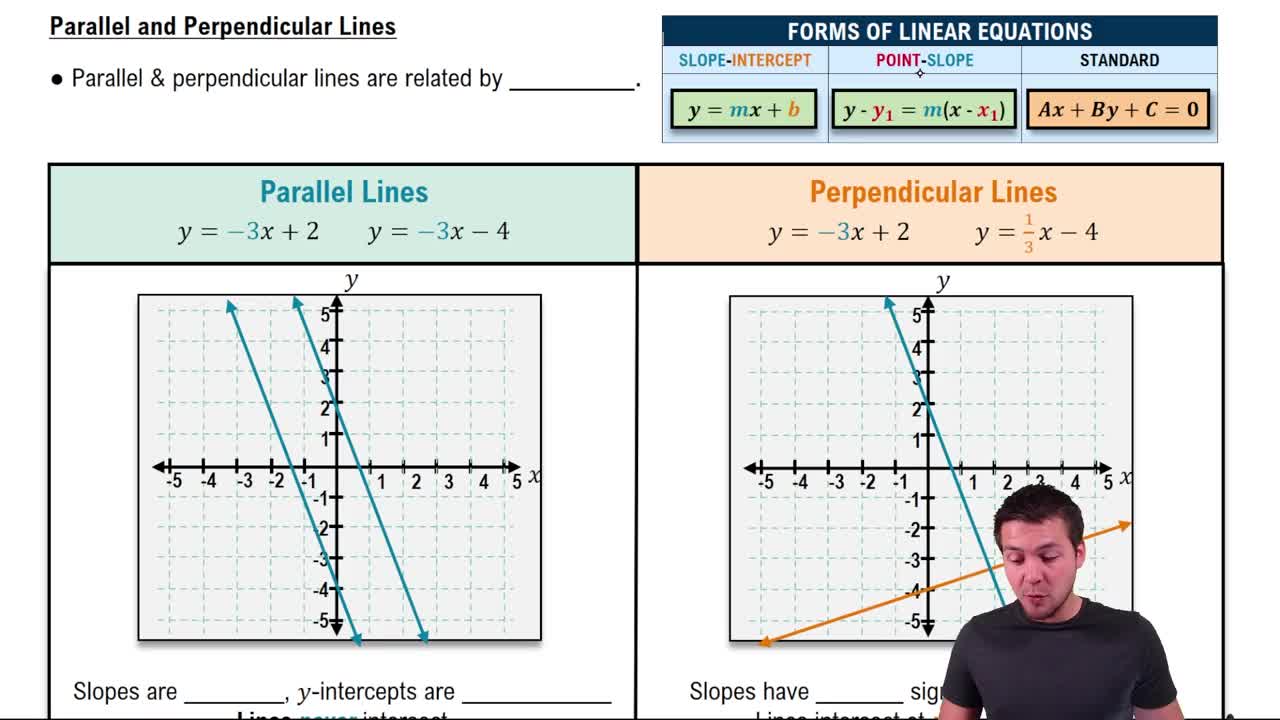
Two lines are perpendicular if the product of their slopes is -1. This means that if one line has a slope of m, the slope of the line perpendicular to it will be -1/m. Understanding this relationship is crucial for finding the slope of the line that is perpendicular to a given line.
The slope of a line can be determined using its x-intercept and y-intercept. The formula for slope (m) is given by m = (y2 - y1) / (x2 - x1). For a line with an x-intercept of 2 and a y-intercept of -4, these intercepts can be used to calculate the slope, which is essential for constructing the equation of the desired line.