If one point on a line is (2, −6) and the line's slope is -3/2, find the y-intercept.
Verified step by step guidance
1
Start with the point-slope form of a line equation: \( y - y_1 = m(x - x_1) \), where \( m \) is the slope and \( (x_1, y_1) \) is a point on the line.
Substitute the given point \((2, -6)\) and the slope \(-\frac{3}{2}\) into the equation: \( y + 6 = -\frac{3}{2}(x - 2) \).
Simplify the equation by distributing the slope on the right side: \( y + 6 = -\frac{3}{2}x + 3 \).
Isolate \( y \) by subtracting 6 from both sides: \( y = -\frac{3}{2}x + 3 - 6 \).
Combine like terms to find the y-intercept: \( y = -\frac{3}{2}x - 3 \). The y-intercept is the constant term, which is the value of \( y \) when \( x = 0 \).
Verified video answer for a similar problem:
This video solution was recommended by our tutors as helpful for the problem above
Video duration:
58s
Play a video:
Was this helpful?
Key Concepts
Here are the essential concepts you must grasp in order to answer the question correctly.
Slope-Intercept Form
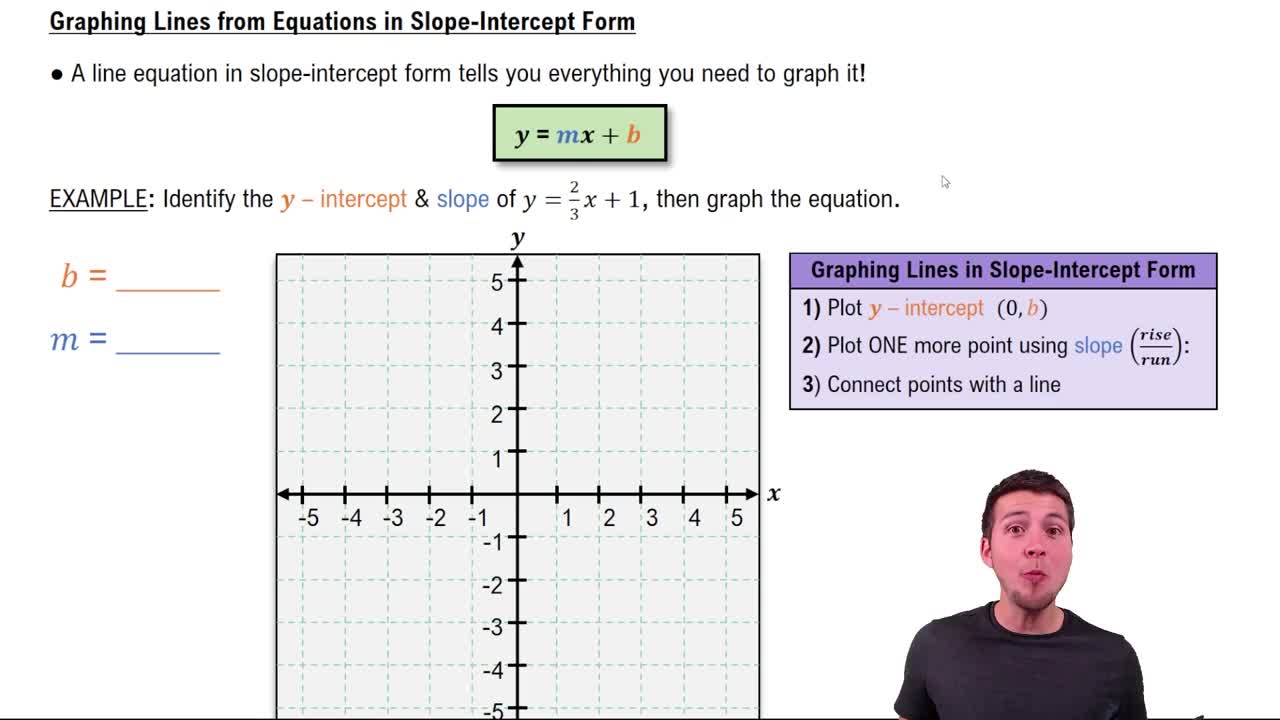
The slope-intercept form of a linear equation is expressed as y = mx + b, where m represents the slope and b is the y-intercept. This form is useful for quickly identifying the slope of a line and where it crosses the y-axis. Understanding this format is essential for solving problems related to linear equations.
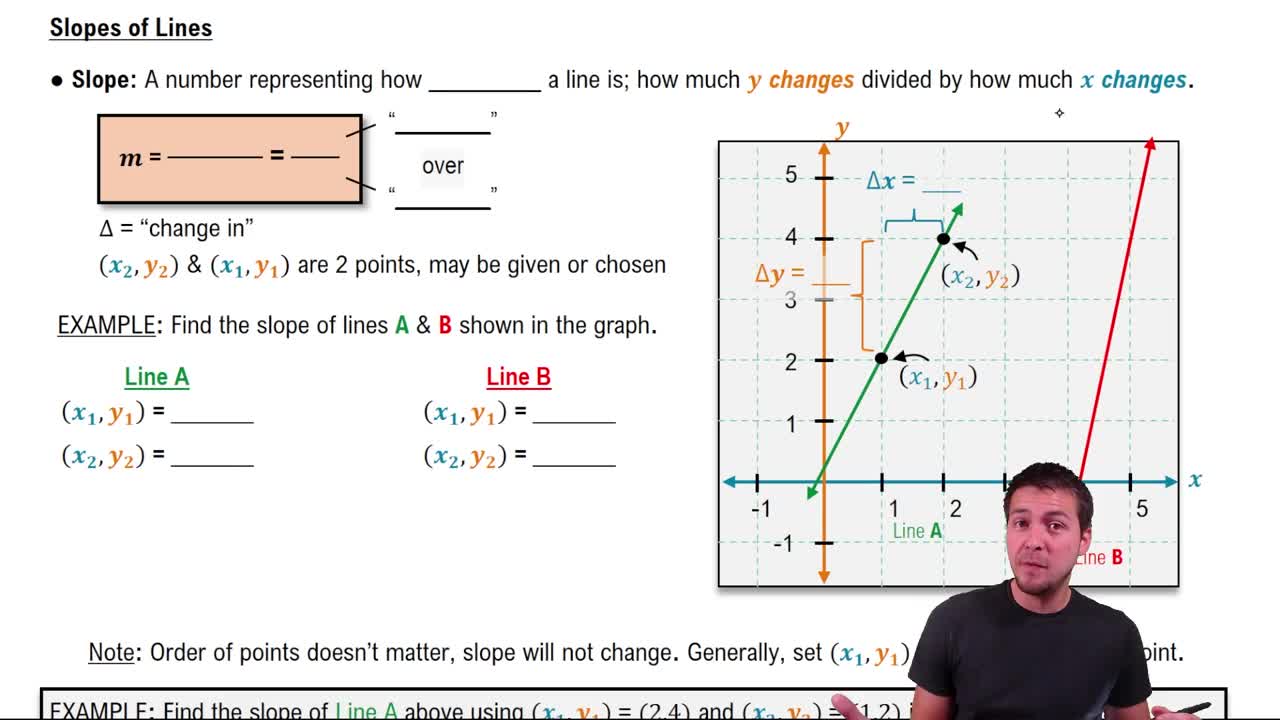
The slope of a line measures its steepness and direction, calculated as the change in y over the change in x (rise over run). A positive slope indicates the line rises from left to right, while a negative slope, such as -3/2, indicates it falls. Knowing how to interpret and use slope is crucial for determining the behavior of linear functions.
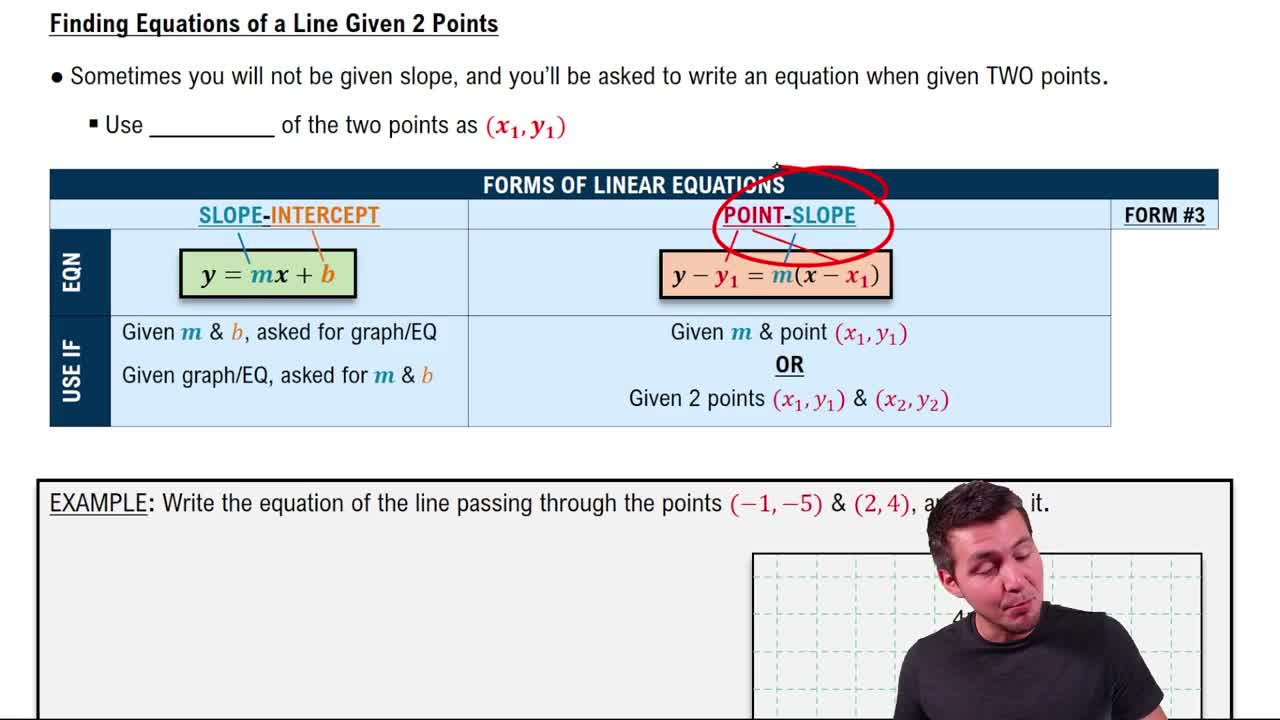
The point-slope form of a linear equation is given by y - y1 = m(x - x1), where (x1, y1) is a known point on the line and m is the slope. This form allows for easy calculation of the equation of a line when a point and the slope are known. It is particularly useful for finding the y-intercept when combined with the slope-intercept form.