Find the slope of the line passing through each pair of points or state that the slope is undefined. Assume that all variables represent positive real numbers. Then indicate whether the line through the points rises, falls, is horizontal, or is vertical. (-a, 0) and (0, -b)
Table of contents
- 0. Review of Algebra4h 18m
- 1. Equations & Inequalities3h 18m
- 2. Graphs of Equations1h 43m
- 3. Functions2h 17m
- 4. Polynomial Functions1h 44m
- 5. Rational Functions1h 23m
- 6. Exponential & Logarithmic Functions2h 28m
- 7. Systems of Equations & Matrices4h 5m
- 8. Conic Sections2h 23m
- 9. Sequences, Series, & Induction1h 22m
- 10. Combinatorics & Probability1h 45m
2. Graphs of Equations
Lines
Problem 55a
Textbook Question
Graph each equation in a rectangular coordinate system. f(x) = 1
Verified step by step guidance1
Identify the type of function: The given equation is f(x) = 1. This is a constant function, meaning the output value (y) is always 1, regardless of the input value (x).
Understand the graph of a constant function: A constant function is represented by a horizontal line on the graph because the y-value does not change as x changes.
Set up the rectangular coordinate system: Draw the x-axis (horizontal) and y-axis (vertical) on a graph. Label the axes and include a scale for both x and y values.
Plot points for the function: Since f(x) = 1, the y-value is always 1. Choose several x-values (e.g., -2, 0, 2) and plot the corresponding points (-2, 1), (0, 1), and (2, 1).
Draw the graph: Connect the plotted points with a straight horizontal line that extends infinitely in both directions. Label the line as f(x) = 1 to complete the graph.
Verified video answer for a similar problem:This video solution was recommended by our tutors as helpful for the problem above
Video duration:
1mPlay a video:
Was this helpful?
Key Concepts
Here are the essential concepts you must grasp in order to answer the question correctly.
Rectangular Coordinate System
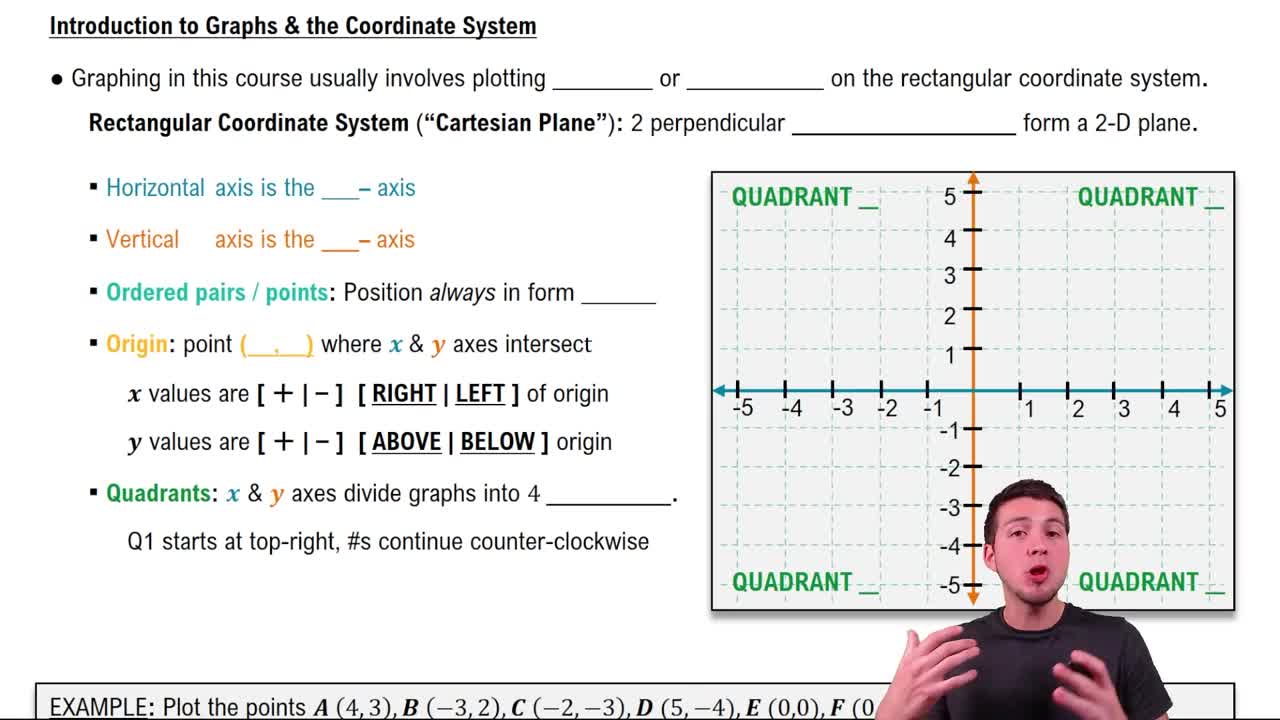
A rectangular coordinate system, also known as the Cartesian coordinate system, consists of two perpendicular axes: the x-axis (horizontal) and the y-axis (vertical). Each point in this system is defined by an ordered pair (x, y), where 'x' represents the horizontal position and 'y' represents the vertical position. Understanding this system is crucial for graphing equations accurately.
Recommended video:
Guided course
Graphs & the Rectangular Coordinate System
Graphing Functions
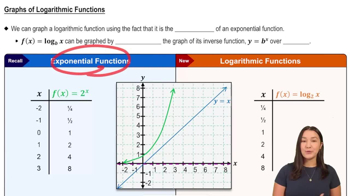
Graphing functions involves plotting points that satisfy the function's equation on the coordinate system. For the function f(x) = 1, this means that for every value of 'x', the output 'f(x)' is always 1. This results in a horizontal line across the y-axis at y = 1, illustrating the concept of constant functions.
Recommended video:
Graphs of Logarithmic Functions
Horizontal Lines
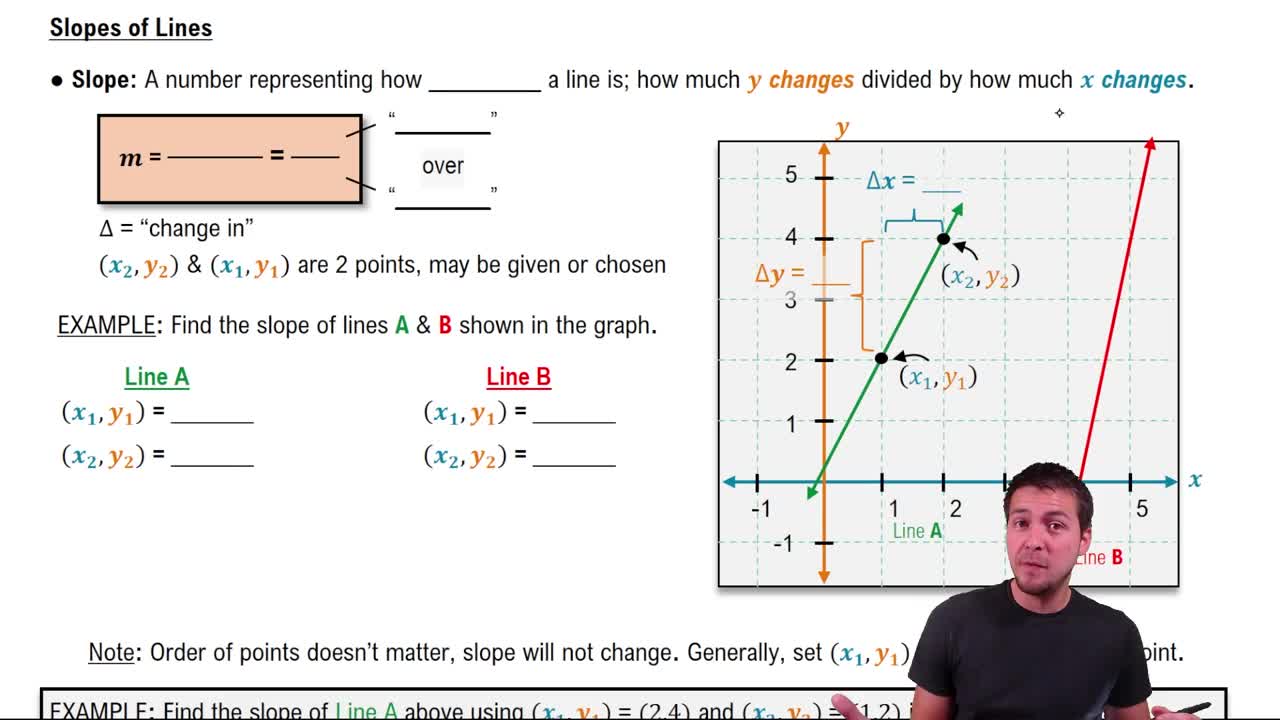
A horizontal line in a coordinate system is characterized by having a constant y-value regardless of the x-value. In the case of the function f(x) = 1, the line will run parallel to the x-axis at the height of y = 1. Recognizing the properties of horizontal lines is essential for understanding how to represent constant functions graphically.
Recommended video:
Guided course
The Slope of a Line
Related Videos
Related Practice
Textbook Question
54
views