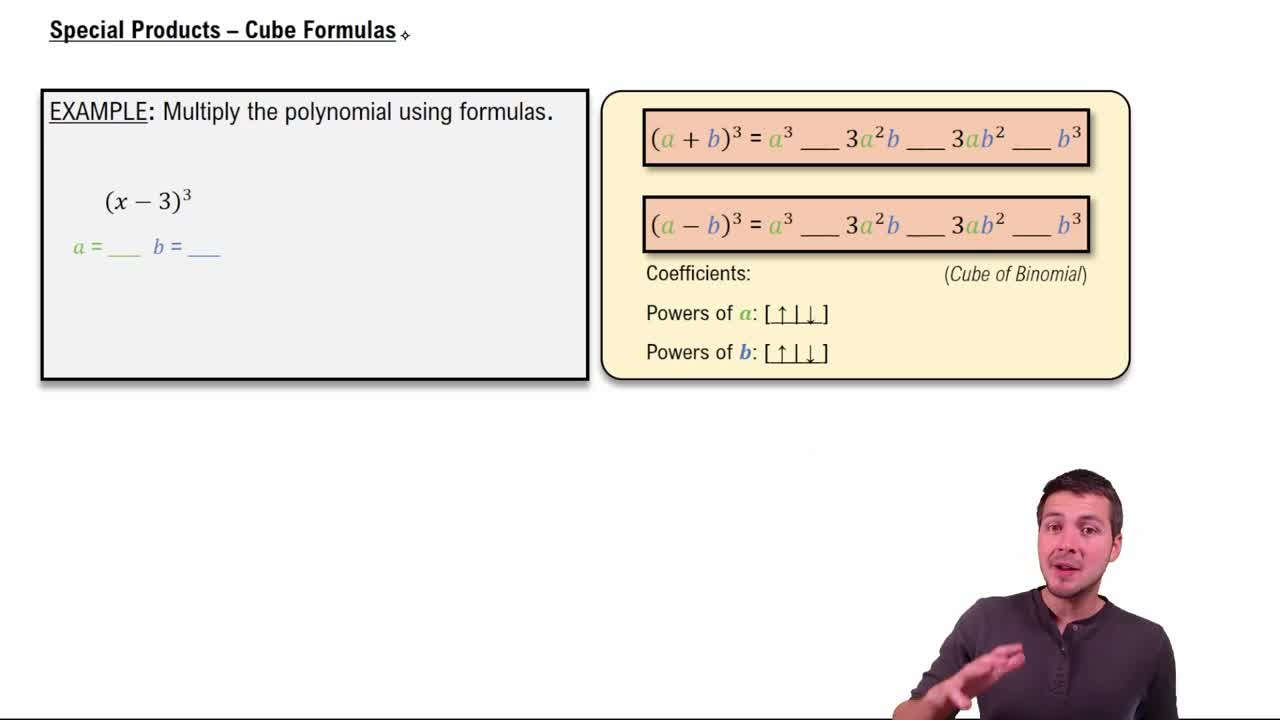
Write the first three terms in the binomial expansion, expressing the result in simplified form. (x-3)^9
Verified step by step guidance
1
Step 1: Recall the Binomial Theorem, which states that the expansion of \((a + b)^n\) is given by \(\sum_{k=0}^{n} \binom{n}{k} a^{n-k} b^k\), where \(\binom{n}{k}\) is the binomial coefficient \(\frac{n!}{k!(n-k)!}\).
Step 2: Identify the values of \(a\), \(b\), and \(n\) in the given expression \((x - 3)^9\). Here, \(a = x\), \(b = -3\), and \(n = 9\).
Step 3: Compute the first term of the expansion (when \(k = 0\)): \(\binom{9}{0} x^{9} (-3)^0\). Simplify this term to \(x^9\).
Step 4: Compute the second term of the expansion (when \(k = 1\)): \(\binom{9}{1} x^{8} (-3)^1\). Simplify \(\binom{9}{1}\) to \(9\), and the term becomes \(-27x^8\).
Step 5: Compute the third term of the expansion (when \(k = 2\)): \(\binom{9}{2} x^{7} (-3)^2\). Simplify \(\binom{9}{2}\) to \(36\), and the term becomes \(324x^7\).
Verified video answer for a similar problem:
This video solution was recommended by our tutors as helpful for the problem above
Video duration:
10m
Play a video:
Was this helpful?
Key Concepts
Here are the essential concepts you must grasp in order to answer the question correctly.
Binomial Theorem
The Binomial Theorem provides a formula for expanding expressions of the form (a + b)^n, where n is a non-negative integer. It states that (a + b)^n can be expressed as the sum of terms in the form of C(n, k) * a^(n-k) * b^k, where C(n, k) is the binomial coefficient. This theorem is essential for determining the coefficients and terms in the expansion of binomials.
Binomial coefficients, denoted as C(n, k) or 'n choose k', represent the number of ways to choose k elements from a set of n elements without regard to the order of selection. They can be calculated using the formula C(n, k) = n! / (k!(n-k)!), where '!' denotes factorial. These coefficients are crucial in the binomial expansion as they determine the weight of each term in the expansion.
Simplification of terms involves combining like terms and reducing expressions to their simplest form. In the context of binomial expansion, this means calculating the individual terms generated by the expansion and then simplifying them by performing arithmetic operations. This process ensures that the final expression is clear and concise, making it easier to interpret and use in further calculations.