Solve each problem. Dimensions of a Square. If the length of each side of a square is decreased by 4 in., the perimeter of the new square is 10 in. more than half the perimeter of the original square. What are the dimensions of the original square?
Table of contents
- 0. Review of Algebra4h 18m
- 1. Equations & Inequalities3h 18m
- 2. Graphs of Equations1h 43m
- 3. Functions2h 17m
- 4. Polynomial Functions1h 44m
- 5. Rational Functions1h 23m
- 6. Exponential & Logarithmic Functions2h 28m
- 7. Systems of Equations & Matrices4h 5m
- 8. Conic Sections2h 23m
- 9. Sequences, Series, & Induction1h 22m
- 10. Combinatorics & Probability1h 45m
1. Equations & Inequalities
Linear Equations
Problem 61
Textbook Question
In the metric system of weights and measures, temperature is measured in degrees Celsius (°C) instead of degrees Fahrenheit (°F). To convert between the two systems, we use the equations. C =5/9 (F-32) and F = 9/5C+32. In each exercise, convert to the other system. Round answers to the nearest tenth of a degree if necessary. 20°C
Verified step by step guidance1
Identify the given temperature and the system it is in. Here, the temperature is 20°C, which is in degrees Celsius.
Since the temperature is given in Celsius and we need to convert it to Fahrenheit, use the conversion formula from Celsius to Fahrenheit: \(F = \frac{9}{5}C + 32\).
Substitute the given Celsius temperature into the formula: \(F = \frac{9}{5} \times 20 + 32\).
Perform the multiplication and addition operations step-by-step to find the Fahrenheit temperature (do not calculate the final value here).
Round the final answer to the nearest tenth of a degree if necessary, as instructed.
Verified video answer for a similar problem:This video solution was recommended by our tutors as helpful for the problem above
Video duration:
2mPlay a video:
Was this helpful?
Key Concepts
Here are the essential concepts you must grasp in order to answer the question correctly.
Linear Equations and Formulas
The temperature conversion formulas between Celsius and Fahrenheit are linear equations. Understanding how to manipulate and apply these formulas allows you to convert temperatures accurately by substituting values and solving for the unknown variable.
Recommended video:
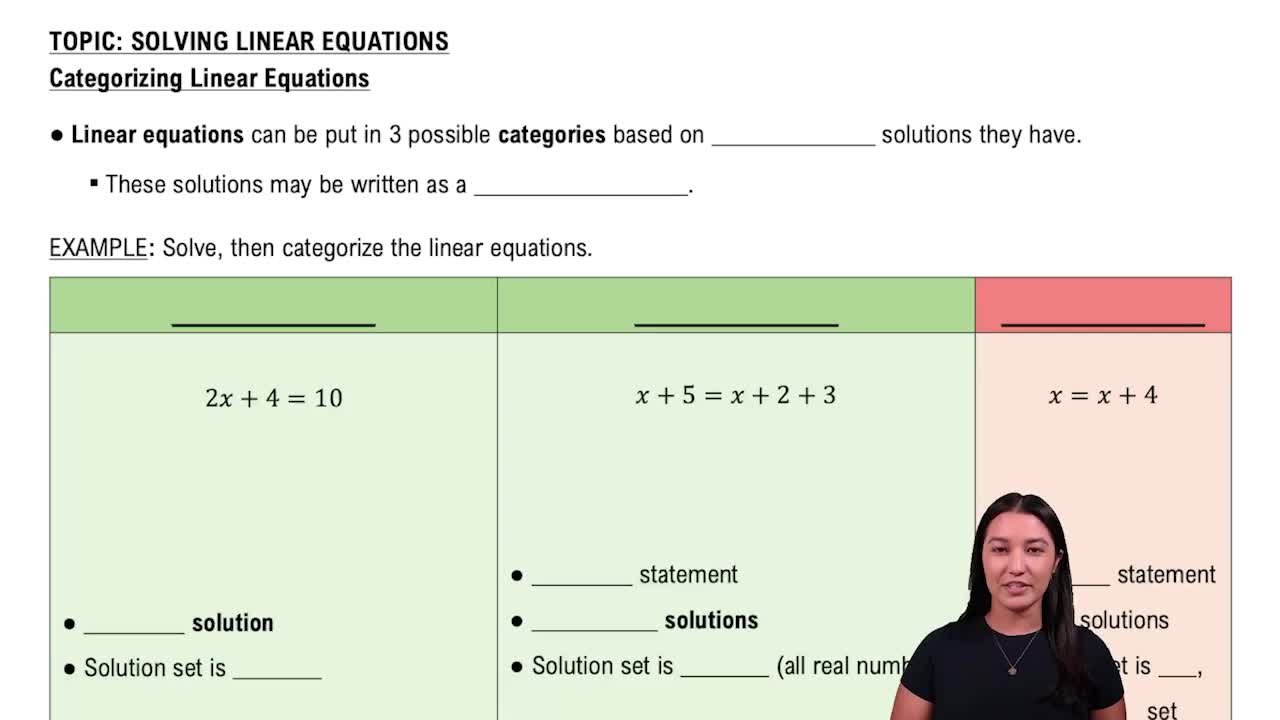
Categorizing Linear Equations
Order of Operations
When using the conversion formulas, it is important to follow the correct order of operations (parentheses, multiplication/division, addition/subtraction) to ensure accurate calculations. For example, subtracting 32 before multiplying by 5/9 is essential in the Celsius conversion.
Recommended video:
Guided course
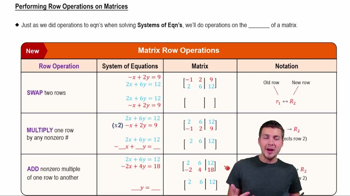
Performing Row Operations on Matrices
Rounding and Significant Figures
After performing the conversion, rounding the result to the nearest tenth is necessary for precision and clarity. Understanding how to round decimal numbers correctly ensures the final answer meets the problem’s requirements.
Recommended video:
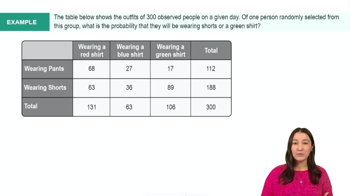
Probability of Non-Mutually Exclusive Events Example
Watch next
Master Introduction to Solving Linear Equtions with a bite sized video explanation from Patrick
Start learningRelated Videos
Related Practice
Textbook Question
333
views