In all exercises, other than exercises with no solution, use interval notation to express solution sets and graph each solution set on a number line. In Exercises 27–50, solve each linear inequality. 5x + 11 < 26
Verified step by step guidance
1
Start with the given inequality: \$5x + 11 < 26$.
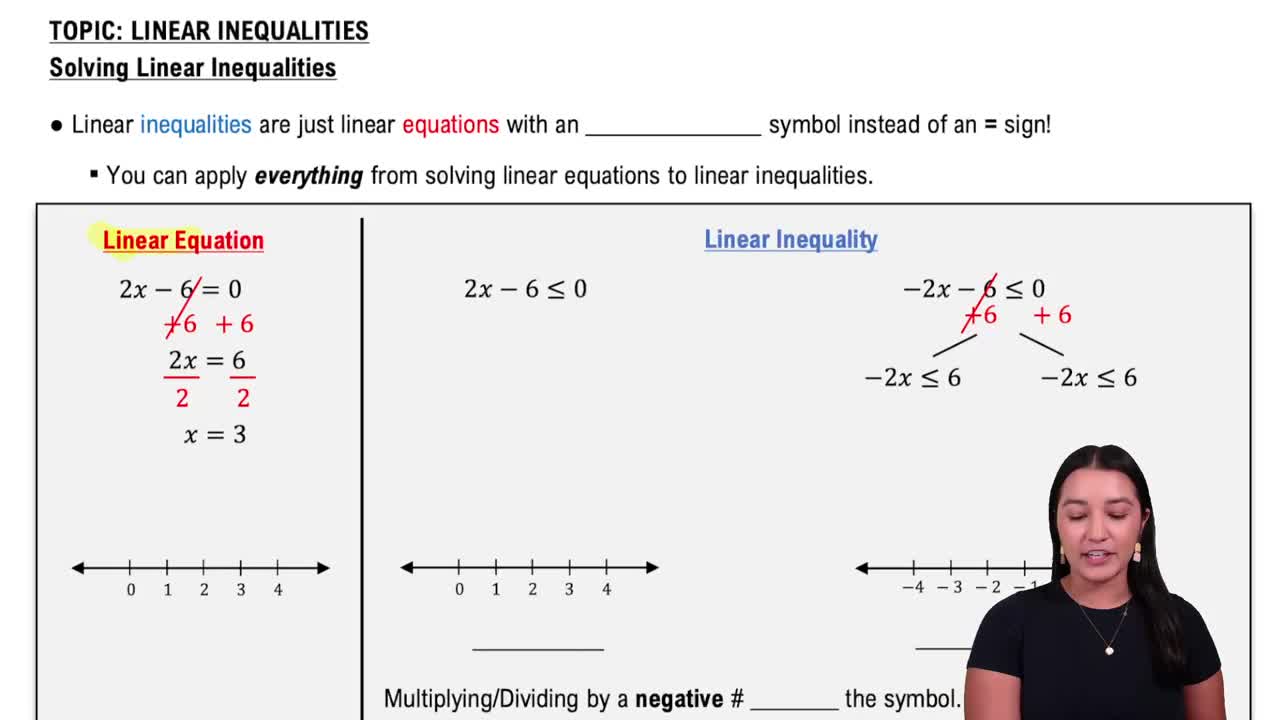
Isolate the term with the variable by subtracting 11 from both sides: \$5x + 11 - 11 < 26 - 11\(, which simplifies to \)5x < 15$.
Next, solve for \(x\) by dividing both sides of the inequality by 5: \(\frac{5x}{5} < \frac{15}{5}\), which simplifies to \(x < 3\).
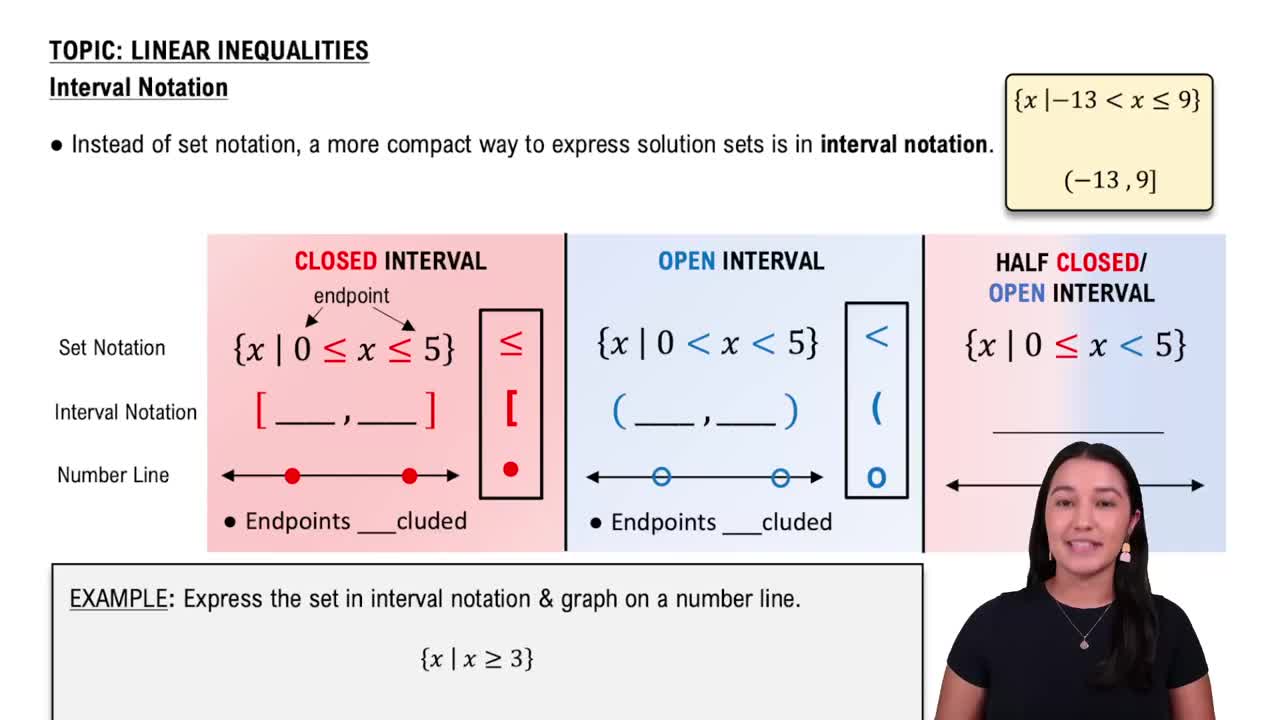
Express the solution set in interval notation. Since \(x\) is less than 3, the solution is all real numbers less than 3, written as \((-\infty, 3)\).
To graph the solution on a number line, draw a number line, place an open circle at 3 (because 3 is not included), and shade all points to the left of 3.
Verified video answer for a similar problem:
This video solution was recommended by our tutors as helpful for the problem above
Video duration:
2m
Play a video:
0 Comments
Key Concepts
Here are the essential concepts you must grasp in order to answer the question correctly.
Solving Linear Inequalities
A linear inequality involves an inequality symbol (<, >, ≤, ≥) with a linear expression. To solve it, isolate the variable by performing inverse operations, similar to solving linear equations, but remember to reverse the inequality sign when multiplying or dividing by a negative number.
Interval notation is a way to represent solution sets of inequalities using parentheses and brackets. Parentheses indicate that an endpoint is not included, while brackets mean it is included. For example, (a, b) means all numbers between a and b, excluding a and b.
Graphing solution sets involves shading the region on a number line that satisfies the inequality. Open circles represent excluded endpoints, and closed circles represent included endpoints. This visual helps understand the range of possible values for the variable.

 2:27 minutes
 Verified step by step guidance
 06:07
06:07