Ch. 7 - Conic Sections
Blitzer - College Algebra 8th Edition
Blitzer8th EditionCollege AlgebraISBN: 9780136970514Not the one you use?Change textbook
Chapter 8, Problem 28

Identify the conic represented by the equation without completing the square. 4x^2 - 9y^2 - 8x + 12y - 144 = 0

Verified step by step guidance
1
Step 1: Begin by identifying the general form of the given equation. The equation is written as 4x^2 - 9y^2 - 8x + 12y - 144 = 0. This is a second-degree equation in two variables (x and y).
Step 2: Group the terms involving x and y separately. The equation can be rewritten as (4x^2 - 8x) + (-9y^2 + 12y) - 144 = 0.
Step 3: Observe the coefficients of the squared terms (4x^2 and -9y^2). Since the coefficients of x^2 and y^2 have opposite signs (one positive and one negative), this indicates that the conic is a hyperbola.
Step 4: Recall the standard form of a hyperbola: \( \frac{(x-h)^2}{a^2} - \frac{(y-k)^2}{b^2} = 1 \) or \( \frac{(y-k)^2}{b^2} - \frac{(x-h)^2}{a^2} = 1 \). The given equation can be transformed into one of these forms by completing the square, but this step is not required here to identify the conic.
Step 5: Conclude that the conic represented by the given equation is a hyperbola based on the signs of the squared terms and their coefficients.

Verified video answer for a similar problem:

This video solution was recommended by our tutors as helpful for the problem above.
Video duration:
3m
Was this helpful?

Key Concepts

Here are the essential concepts you must grasp in order to answer the question correctly.

Conic Sections

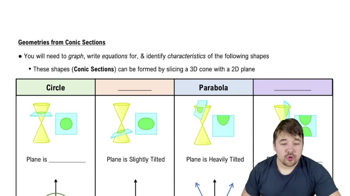
Conic sections are the curves obtained by intersecting a plane with a double-napped cone. The four primary types of conic sections are circles, ellipses, parabolas, and hyperbolas. Each type has a distinct equation and geometric properties, which can be identified by analyzing the coefficients of the quadratic terms in the equation.
Recommended video:
3:08
Geometries from Conic Sections

Standard Form of Conic Equations

Conic sections can be expressed in standard forms, which help identify their type. For example, the standard form of a circle is (x-h)² + (y-k)² = r², while a hyperbola is represented as (x-h)²/a² - (y-k)²/b² = 1. By rearranging the given equation into a recognizable standard form, one can determine the specific conic section it represents.
Recommended video:
3:08
Geometries from Conic Sections

Discriminant of Conic Sections

The discriminant of a conic section, given by the formula D = B² - 4AC from the general form Ax² + Bxy + Cy² + Dx + Ey + F = 0, helps classify the conic. If D < 0, the conic is an ellipse (or circle); if D = 0, it is a parabola; and if D > 0, it is a hyperbola. This classification is crucial for identifying the type of conic represented by the equation.
Recommended video:
3:08
Geometries from Conic Sections