Solve each system in Exercises 12–13. The is a piecewise function
Verified step by step guidance
1
Identify the given piecewise function and understand its structure. A piecewise function is defined by different expressions depending on the value of the input variable. For example, it might look like f(x) = {x^2 if x < 0, 2x + 1 if x >= 0}.
Determine the specific intervals for each piece of the function. For instance, one part of the function might apply when x < 0, and another part might apply when x >= 0. Clearly note these intervals.
For each interval, solve the system of equations or evaluate the function as required. For example, if solving for f(x) = 0, solve each piece of the function separately within its respective interval.
Check for continuity or any points of intersection between the pieces of the function. This involves evaluating the function at the boundaries of the intervals (e.g., x = 0 in the example above) to ensure the function transitions smoothly or to identify any discontinuities.
Combine the solutions from each interval to form the complete solution to the system. Ensure that each solution corresponds to the correct interval of the piecewise function.
Verified video answer for a similar problem:
This video solution was recommended by our tutors as helpful for the problem above
Video duration:
7m
Play a video:
0 Comments
Key Concepts
Here are the essential concepts you must grasp in order to answer the question correctly.
Piecewise Functions
A piecewise function is defined by multiple sub-functions, each applying to a specific interval of the function's domain. This means that the function can have different expressions based on the input value. Understanding how to interpret and evaluate these functions is crucial for solving problems involving them, as it requires identifying which piece of the function to use for a given input.
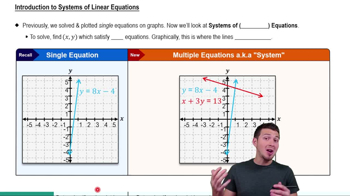
A system of equations consists of two or more equations that share common variables. The goal is to find the values of these variables that satisfy all equations simultaneously. Solving such systems can involve methods like substitution, elimination, or graphical representation, and is essential for understanding how different equations interact with one another.
Graphing techniques involve plotting equations on a coordinate plane to visually represent their solutions. For piecewise functions and systems of equations, understanding how to accurately graph each piece or equation helps in identifying points of intersection, which represent the solutions to the system. Mastery of graphing is vital for interpreting the behavior of functions and their relationships.

 7:44 minutes
 Verified step by step guidance
 4:56
4:56