In Exercises 81–88, a. Find the slant asymptote of the graph of each rational function and b. Follow the seven-step strategy and use the slant asymptote to graph each rational function. f(x)=(x2−1)/x
Table of contents
- 0. Review of Algebra4h 18m
- 1. Equations & Inequalities3h 18m
- 2. Graphs of Equations1h 43m
- 3. Functions2h 17m
- 4. Polynomial Functions1h 44m
- 5. Rational Functions1h 23m
- 6. Exponential & Logarithmic Functions2h 28m
- 7. Systems of Equations & Matrices4h 5m
- 8. Conic Sections2h 23m
- 9. Sequences, Series, & Induction1h 22m
- 10. Combinatorics & Probability1h 45m
5. Rational Functions
Graphing Rational Functions
Problem 59
Textbook Question
Follow the seven steps to graph each rational function. f(x)=2x/(x2−4)
Verified step by step guidance1
Identify the domain of the function by finding the values of \(x\) that make the denominator zero. Solve the equation \(x^{2} - 4 = 0\) to find these values.
Determine the vertical asymptotes by setting the denominator equal to zero and solving for \(x\). These are the values excluded from the domain where the function tends to infinity.
Find the horizontal asymptote by comparing the degrees of the numerator and denominator. Since the numerator is degree 1 and the denominator is degree 2, the horizontal asymptote is \(y = 0\).
Calculate the \(x\)-intercepts by setting the numerator equal to zero and solving for \(x\). This gives the points where the graph crosses the \(x\)-axis.
Calculate the \(y\)-intercept by evaluating \(f(0)\), substituting \(x=0\) into the function to find where the graph crosses the \(y\)-axis.
Was this helpful?
Key Concepts
Here are the essential concepts you must grasp in order to answer the question correctly.
Domain of a Rational Function
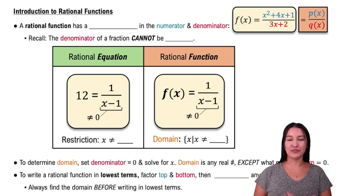
The domain of a rational function includes all real numbers except where the denominator equals zero. For f(x) = 2x/(x²−4), set the denominator x²−4 = 0 to find excluded values, which are x = ±2. Understanding the domain helps identify vertical asymptotes and restrictions on the graph.
Recommended video:
Intro to Rational Functions
Asymptotes of Rational Functions
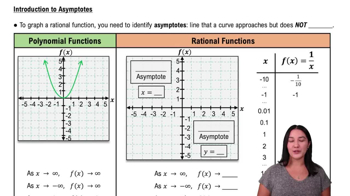
Asymptotes are lines that the graph approaches but never touches. Vertical asymptotes occur where the denominator is zero (and numerator is nonzero), while horizontal asymptotes describe end behavior based on degrees of numerator and denominator. For f(x) = 2x/(x²−4), vertical asymptotes are at x = ±2, and the horizontal asymptote is y = 0.
Recommended video:
Introduction to Asymptotes
Graphing Steps for Rational Functions
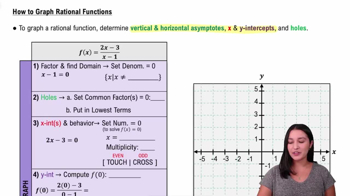
Graphing rational functions involves seven steps: finding the domain, intercepts, asymptotes, analyzing end behavior, plotting points, and sketching the curve. Each step builds understanding of the function’s behavior, ensuring an accurate and complete graph of f(x) = 2x/(x²−4).
Recommended video:
How to Graph Rational Functions
Watch next
Master Graphing Rational Functions Using Transformations with a bite sized video explanation from Patrick
Start learningRelated Videos
Related Practice
Textbook Question
462
views