In Exercises 81–88, a. Find the slant asymptote of the graph of each rational function and b. Follow the seven-step strategy and use the slant asymptote to graph each rational function. f(x)=(x3+1)/(x2+2x)
Table of contents
- 0. Review of Algebra4h 18m
- 1. Equations & Inequalities3h 18m
- 2. Graphs of Equations1h 43m
- 3. Functions2h 17m
- 4. Polynomial Functions1h 44m
- 5. Rational Functions1h 23m
- 6. Exponential & Logarithmic Functions2h 28m
- 7. Systems of Equations & Matrices4h 5m
- 8. Conic Sections2h 23m
- 9. Sequences, Series, & Induction1h 22m
- 10. Combinatorics & Probability1h 45m
5. Rational Functions
Graphing Rational Functions
Problem 65
Textbook Question
Follow the seven steps to graph each rational function. f(x)=− 1/(x2−4)
Verified step by step guidance1
Identify the domain of the function by finding the values of \(x\) that make the denominator zero. Set the denominator equal to zero: \(x^{2} - 4 = 0\).
Solve the equation \(x^{2} - 4 = 0\) by factoring it as \((x - 2)(x + 2) = 0\), which gives the values \(x = 2\) and \(x = -2\). These values are excluded from the domain because they make the denominator zero, causing vertical asymptotes.
Determine the vertical asymptotes by noting that the function is undefined at \(x = 2\) and \(x = -2\). So, draw vertical dashed lines at these \(x\)-values.
Find the horizontal asymptote by analyzing the degrees of the numerator and denominator. The numerator is a constant (\(-1\)), and the denominator is a quadratic (\(x^{2} - 4\)). Since the degree of the denominator is greater than the numerator, the horizontal asymptote is \(y = 0\).
Create a table of values by choosing \(x\)-values around the vertical asymptotes (for example, values less than \(-2\), between \(-2\) and \$2\(, and greater than \)2\(), then calculate the corresponding \)f(x)$ values to understand the behavior of the graph in each interval.
Was this helpful?
Key Concepts
Here are the essential concepts you must grasp in order to answer the question correctly.
Rational Functions
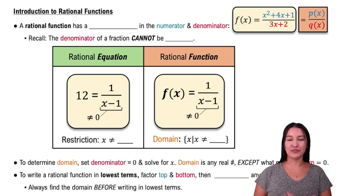
A rational function is a ratio of two polynomials, expressed as f(x) = P(x)/Q(x). Understanding its domain, zeros, and behavior is essential, especially where the denominator equals zero, causing vertical asymptotes or undefined points.
Recommended video:
Intro to Rational Functions
Asymptotes of Rational Functions
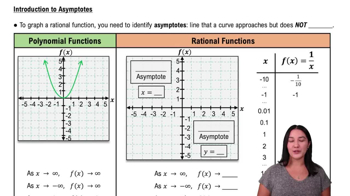
Asymptotes are lines that the graph approaches but never touches. Vertical asymptotes occur where the denominator is zero, and horizontal or oblique asymptotes describe end behavior as x approaches infinity or negative infinity.
Recommended video:
Introduction to Asymptotes
Graphing Steps for Rational Functions
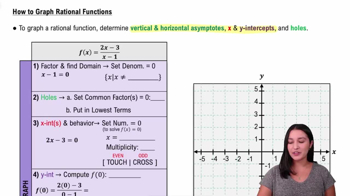
Graphing involves identifying domain restrictions, intercepts, asymptotes, and behavior near asymptotes, then plotting points to sketch the curve. Following a systematic approach ensures an accurate representation of the function.
Recommended video:
How to Graph Rational Functions
Watch next
Master Graphing Rational Functions Using Transformations with a bite sized video explanation from Patrick
Start learningRelated Videos
Related Practice
Textbook Question
436
views