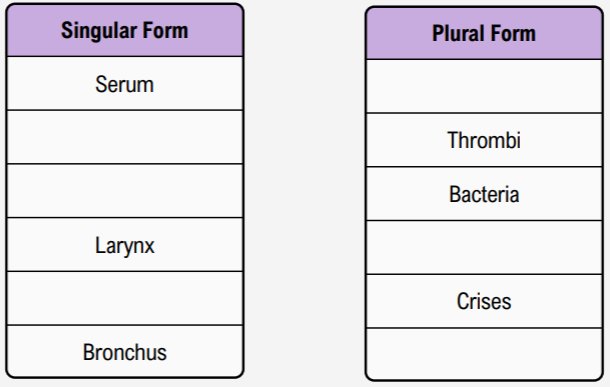
Understanding the formation of plural endings in medical and scientific terminology often involves recognizing patterns derived from Greek and Latin roots. While some plural forms follow straightforward English rules, many require specific changes based on their original language.
For words ending in y, the plural is formed by replacing the y with ies, such as artery becoming arteries and biopsy becoming biopsies. Similarly, words ending in is change to es in the plural, for example, diagnosis becomes diagnoses. These two rules are English-based and do not require complex memory aids.
When dealing with Latin or Greek origins, the pluralization rules become more specialized. Words ending in us change to i in the plural form, such as nucleus to nuclei and fungus to fungi. A helpful mnemonic is to think of a group where "us" leaves and becomes just "i," simplifying the transition.
For singular nouns ending in a, the plural is formed by adding an e, turning vertebra into vertebrae. This can be remembered by associating vowels: a pairs with e, while other vowels like i, o, u follow different rules.
Nouns ending in um or on form their plurals by replacing these endings with a. For example, ovum becomes ova and ganglion becomes ganglia. A mnemonic to recall this is "umpires on base arguing," linking um and on endings to the plural a.
Less commonly, nouns ending in en change to ina in the plural, such as foramen becoming foramina. This can be remembered by the phrase "entertaining at the marina," associating en with ina.
Words ending in nx form plurals by replacing nx with nges. For instance, phalanx becomes phalanges. Since phalanges are digits in the fingers, one can recall this by thinking of counting digits and gestures.
Finally, nouns ending in ax, ex, or ix form plurals by replacing these endings with ces. Examples include thorax becoming thoraces and appendix becoming appendices. A useful mnemonic is "x out bad habits," symbolizing the removal of x and replacement with ces.
These pluralization rules highlight the importance of understanding the linguistic roots of terms, especially in medical and scientific contexts. Recognizing these patterns not only aids in correct usage but also enhances vocabulary retention and comprehension.