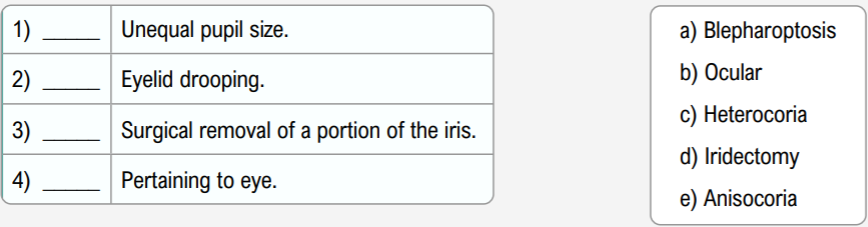
Understanding the combining forms related to the structure of the eye is essential for grasping medical terminology in ophthalmology. The term oculo refers broadly to the eye itself, as seen in words like "binoculars," which relate to both eyes. The prefixes opto or optico are connected to vision or the eye's function, exemplified by "optometry," the study of eye care and vision correction.
The combining form blepharo pertains to the eyelid, reminding us of blinking, which involves the eyelids closing. The term choroido relates to the choroid, a pigmented vascular layer of the eye situated between the retina and the sclera, crucial for nourishing the outer retina.
Irido or irido connects to the iris, the colored part of the eye responsible for controlling the diameter and size of the pupil. The coreo form refers specifically to the pupil, the black circular opening in the iris that regulates light entry into the eye. This function is vital for vision clarity and protection from excessive light.
The term cyclo is associated with the ciliary body, which contains the ciliary muscles responsible for lens shape adjustment during focusing. Phaco or lento relates to the lens itself, the transparent structure that focuses light onto the retina, enabling clear vision.
Papillo refers to the optic disc, the point where the optic nerve exits the eye. The optic nerve is an extension of the retina, transmitting visual information to the brain. Understanding this connection is key to comprehending how visual signals are processed.
Lastly, cryo and lacrimal pertain to tears and tear production. The lacrimal glands produce tears that lubricate and protect the eye surface. The term chromato relates to color, important in describing structures or images that involve multiple colors, such as polychromatic images.
Familiarity with these combining forms enhances comprehension of eye anatomy and related medical terminology, facilitating better understanding of conditions, treatments, and diagnostic procedures involving the eye.