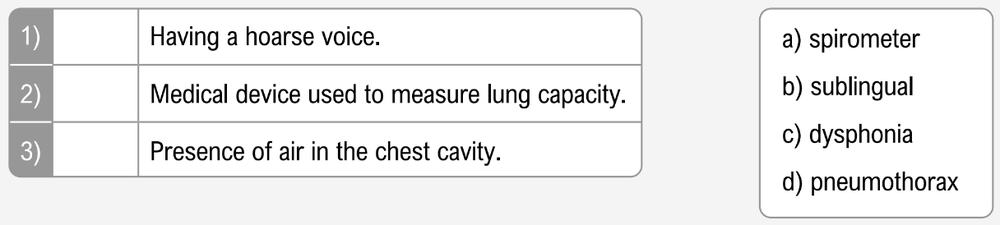
The respiratory system is composed of various key components, each associated with specific combining forms that help describe their functions and relationships. The term aero refers to air, as seen in words like "aerobics," which involve air or oxygen. The prefixes pneumo and pneumono relate to both air and the lungs, exemplified by the word "pneumonia," a lung infection. The term freno is connected to the diaphragm, a crucial muscle that plays a pivotal role in respiration by aiding lung expansion and contraction.
Additionally, lingual pertains to the tongue, which, while not directly part of the respiratory tract, is important in speech and airway management. The prefixes halo, palato, and spiro are all associated with the act of breathing. For instance, inhalation involves drawing air into the lungs, while inspiration and expiration describe the processes of breathing in and out, respectively. Finally, phono relates to voice and sound production, highlighting the connection between respiration and vocalization, as when speaking on the phone.
Understanding these combining forms enhances comprehension of respiratory system terminology and its functions, linking the physiological processes of air movement, lung function, diaphragm activity, and voice production into a cohesive framework.