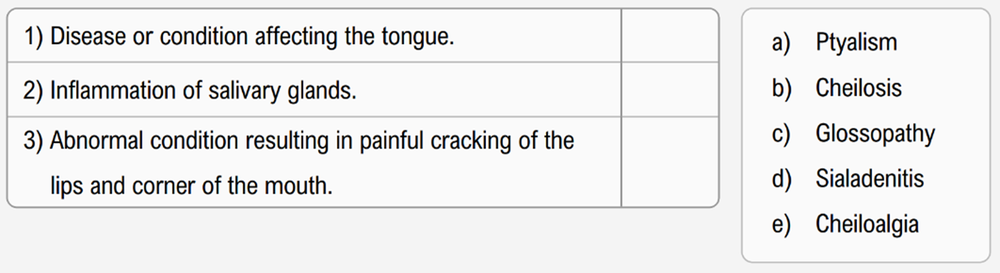
Understanding the combining forms related to the digestive system enhances comprehension of medical terminology and anatomy. The term stomato refers to the mouth, which can be remembered by associating "stomato" with "mouth eats tomato." Similarly, buccal pertains to the cheek, evoking the image of a "cheeky buck" with puffed cheeks. The combining form cheilo relates to the lip, which can be recalled by thinking of "chi lip" or "kite lip."
Glosso signifies the tongue, easily remembered by picturing a "glossy tongue." The terms sialo and tyalo both connect to saliva and salivary glands, with "sialo" referring specifically to saliva or the glands, and "tyalo" emphasizing the process of salivation, as in "salivating on tile."
Halito means breath, often recognized in the context of "halitosis," which describes unpleasant breath. The combining forms bilo and chol relate to bile and gall, essential components in digestion and liver function, as seen in terms like "bicholesterol."
Cysto denotes a bladder or sac, which can be linked to the idea of a "bladder assist," helping to remember its meaning. Lastly, procto refers to the anus or rectum, familiar from the term "proctologist," a specialist who examines these areas.
These combining forms serve as foundational building blocks in medical language, enabling precise description of anatomical structures and physiological processes within the digestive system. Recognizing and recalling these terms through mnemonic devices supports deeper understanding and effective communication in healthcare contexts.