The total number of cases of a disease in a given area is its __________.
Ch. 14 - Infection, Infectious Diseases, and Epidemiology
Bauman6th EditionMicrobiology with Diseases by TaxonomyISBN: 9780134832302Not the one you use?Change textbook
Chapter 14, Problem 8
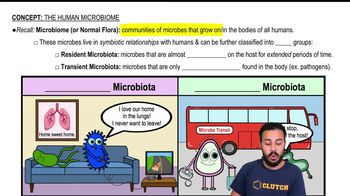
In general, contrast transient microbiota with resident microbiota.
Verified step by step guidance1
Step 1: Define transient microbiota as microorganisms that temporarily colonize the body but do not establish permanent residence. They can be present for hours, days, or weeks but are eventually removed by the body's defenses or competition with resident microbes.
Step 2: Define resident microbiota as the microorganisms that permanently colonize specific areas of the body under normal conditions. These microbes are stable, often beneficial, and form a consistent part of the body's microbial community.
Step 3: Explain that transient microbiota are often acquired through contact with the environment, other people, or objects, and their presence is usually short-lived due to factors like immune response, physical removal, or competition.
Step 4: Highlight that resident microbiota play important roles in protecting against pathogens, aiding digestion, and supporting the immune system, whereas transient microbiota typically do not have these established roles.
Step 5: Summarize the contrast by emphasizing that transient microbiota are temporary and variable, while resident microbiota are permanent and stable components of the body's microbiome.

Verified video answer for a similar problem:
This video solution was recommended by our tutors as helpful for the problem above.
Video duration:
3mWas this helpful?
Key Concepts
Here are the essential concepts you must grasp in order to answer the question correctly.
Resident Microbiota
Resident microbiota are the microorganisms that permanently inhabit specific areas of the human body, such as the skin, gut, and respiratory tract. They form stable communities that often provide beneficial functions like aiding digestion and protecting against pathogens.
Recommended video:
Guided course
The Human Microbiome
Transient Microbiota
Transient microbiota are temporary microorganisms that colonize the body for short periods without establishing permanent residence. They may be acquired through contact with the environment or other individuals and are usually eliminated by the immune system or competition with resident microbes.
Recommended video:
Guided course
The Human Microbiome
Differences in Duration and Impact
The main difference between transient and resident microbiota lies in their duration and role; resident microbiota persist long-term and contribute to health, while transient microbiota are short-lived and may be harmless or potentially pathogenic. Understanding this distinction is key to studying microbial interactions with the host.
Recommended video:
Guided course
Glucose's Impact on Lac Operon Example 1
Related Practice
Textbook Question
1185
views
Textbook Question
The nature of bacterial capsules ___________ .
a. Causes widespread blood clotting
b. Allows phagocytes to readily engulf these bacteria
c. Affects the virulence of these bacteria
d. Has no effect on the virulence of bacteria
1349
views
Textbook Question
Bacteria that convert nitrogen gas into ammonia are:
a. Nitrifying bacteria
b. Nitrogenous
c. Nitrogen fixers
d. Nitrification bacteria
1587
views
Textbook Question
__________ infections are those acquired by patients or staff while in health care facilities.
1025
views
Textbook Question
Contrast the terms infection and morbidity.
1350
views
Textbook Question
Which of the following are most likely to cause disease?
a. Opportunistic pathogens in a weakened host
b. Pathogens lacking the enzyme kinase
c. Pathogens lacking the enzyme collagenase
d. Highly virulent organisms
1159
views