
Ch. 13 - Characterizing and Classifying Viruses, Viroids, and Prions
Bauman - Microbiology with Diseases by Taxonomy 6th Edition
Bauman6th EditionMicrobiology with Diseases by TaxonomyISBN: 9780134832302Not the one you use?Change textbook
Chapter 13, Problem 7

How is a provirus like a prophage? How is it different?

Verified step by step guidance
1
Step 1: Understand the definitions of both terms. A prophage is the viral DNA of a bacteriophage that has integrated into the bacterial host genome, while a provirus is the viral DNA of a virus (often a retrovirus) that has integrated into the genome of a eukaryotic host cell.
Step 2: Identify the similarity: Both a prophage and a provirus represent a latent form of the virus where the viral genetic material is integrated into the host's genome and can be replicated along with the host DNA without causing immediate lysis or destruction of the host cell.
Step 3: Recognize the difference in host type: A prophage is specific to bacterial hosts (prokaryotes), whereas a provirus is found in eukaryotic host cells.
Step 4: Note the difference in viral life cycle: Prophages can enter the lytic cycle, where they excise themselves and produce new phage particles leading to host cell lysis. Proviruses, especially retroviruses, typically remain integrated and may produce new viruses without necessarily killing the host cell immediately.
Step 5: Summarize that both represent viral latency through genome integration, but differ mainly in the type of host organism and the details of their replication and activation cycles.

Verified video answer for a similar problem:

This video solution was recommended by our tutors as helpful for the problem above.
Video duration:
3m
Was this helpful?

Key Concepts

Here are the essential concepts you must grasp in order to answer the question correctly.

Provirus

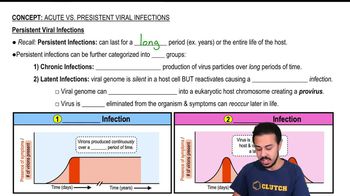
A provirus is the viral genome of a virus that integrates into the DNA of a eukaryotic host cell. It remains dormant within the host's genome and can be replicated along with the host's DNA, potentially reactivating to produce new viruses later.
Recommended video:
Guided course
05:12
Persistent Viral Infections

Prophage

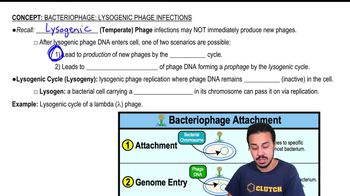
A prophage is the viral DNA of a bacteriophage that has integrated into the bacterial host's genome. Like a provirus, it remains latent and replicates with the host DNA, but it specifically refers to viruses infecting bacteria.
Recommended video:
Guided course
05:27
Bacteriophage: Lysogenic Phage Infections

Similarity and Difference between Provirus and Prophage

Both provirus and prophage represent integrated viral genomes that remain dormant within host DNA and replicate with it. The key difference is that a provirus infects eukaryotic cells, while a prophage infects bacterial cells. Additionally, prophages can enter a lytic cycle more readily, causing host cell lysis.
Recommended video:
Guided course
05:32
Reviewing the Different Types of Microscopes