- 0. Basic Principles of Economics1h 5m
- Introduction to Economics3m
- People Are Rational2m
- People Respond to Incentives1m
- Scarcity and Choice2m
- Marginal Analysis9m
- Allocative Efficiency, Productive Efficiency, and Equality7m
- Positive and Normative Analysis7m
- Microeconomics vs. Macroeconomics2m
- Factors of Production5m
- Circular Flow Diagram5m
- Graphing Review10m
- Percentage and Decimal Review4m
- Fractions Review2m
- 1. Reading and Understanding Graphs59m
- 2. Introductory Economic Models1h 10m
- 3. The Market Forces of Supply and Demand2h 26m
- Competitive Markets10m
- The Demand Curve13m
- Shifts in the Demand Curve24m
- Movement Along a Demand Curve5m
- The Supply Curve9m
- Shifts in the Supply Curve22m
- Movement Along a Supply Curve3m
- Market Equilibrium8m
- Using the Supply and Demand Curves to Find Equilibrium3m
- Effects of Surplus3m
- Effects of Shortage2m
- Supply and Demand: Quantitative Analysis40m
- 4. Elasticity2h 26m
- Percentage Change and Price Elasticity of Demand19m
- Elasticity and the Midpoint Method20m
- Price Elasticity of Demand on a Graph11m
- Determinants of Price Elasticity of Demand6m
- Total Revenue Test13m
- Total Revenue Along a Linear Demand Curve14m
- Income Elasticity of Demand23m
- Cross-Price Elasticity of Demand11m
- Price Elasticity of Supply12m
- Price Elasticity of Supply on a Graph3m
- Elasticity Summary9m
- 5. Consumer and Producer Surplus; Price Ceilings and Floors3h 45m
- Consumer Surplus and Willingness to Pay38m
- Producer Surplus and Willingness to Sell26m
- Economic Surplus and Efficiency18m
- Quantitative Analysis of Consumer and Producer Surplus at Equilibrium28m
- Price Ceilings, Price Floors, and Black Markets38m
- Quantitative Analysis of Price Ceilings and Price Floors: Finding Points20m
- Quantitative Analysis of Price Ceilings and Price Floors: Finding Areas54m
- 6. Introduction to Taxes and Subsidies1h 46m
- 7. Externalities1h 12m
- 8. The Types of Goods1h 13m
- 9. International Trade1h 16m
- 10. The Costs of Production2h 35m
- 11. Perfect Competition2h 24m
- Introduction to the Four Market Models2m
- Characteristics of Perfect Competition6m
- Revenue in Perfect Competition14m
- Perfect Competition Profit on the Graph20m
- Short Run Shutdown Decision34m
- Long Run Entry and Exit Decision18m
- Individual Supply Curve in the Short Run and Long Run6m
- Market Supply Curve in the Short Run and Long Run9m
- Long Run Equilibrium12m
- Perfect Competition and Efficiency15m
- Four Market Model Summary: Perfect Competition5m
- 12. Monopoly2h 13m
- Characteristics of Monopoly21m
- Monopoly Revenue12m
- Monopoly Profit on the Graph16m
- Monopoly Efficiency and Deadweight Loss20m
- Price Discrimination22m
- Antitrust Laws and Government Regulation of Monopolies11m
- Mergers and the Herfindahl-Hirschman Index (HHI)17m
- Four Firm Concentration Ratio6m
- Four Market Model Summary: Monopoly4m
- 13. Monopolistic Competition1h 9m
- 14. Oligopoly1h 26m
- 15. Markets for the Factors of Production1h 26m
- 16. Income Inequality and Poverty36m
- 17. Asymmetric Information, Voting, and Public Choice39m
- 18. Consumer Choice and Behavioral Economics1h 16m
PPF - Comparative Advantage and Trade: Videos & Practice Problems
Trading helps us reach levels of consumption that were previously unattainable. Team work makes the dream work!
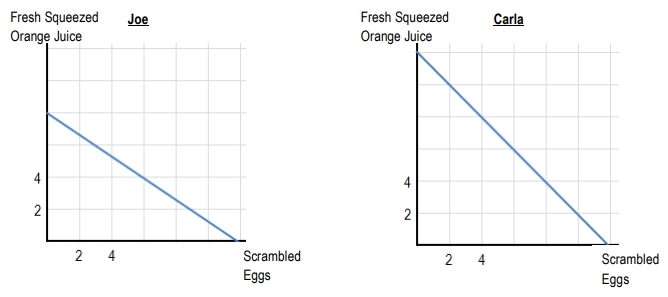
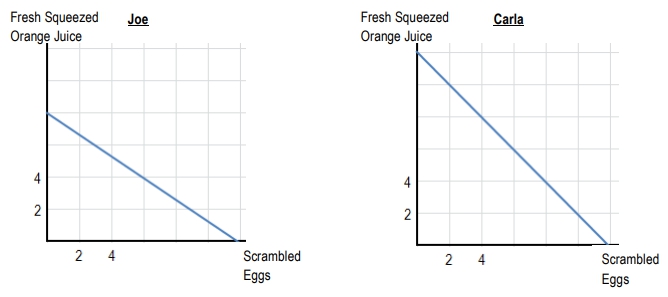
If Joe and Carla plan to specialize and trade, what should Joe produce?


If Joe and Carla plan to specialize and trade, what should Carla produce?

Assume that Joe and Carla will trade Scrambled Eggs and Fresh Squeezed Orange Juice at a rate of 1.2 Eggs for 1 OJ. If Joe's consumption after trade includes six eggs, what will be Carla's consumption after trade?

Do you want more practice?
More setsGo over this topic definitions with flashcards
More setsHere's what students ask on this topic:
Comparative advantage is the principle that a person or country should specialize in producing the good for which they have the lowest opportunity cost. Opportunity cost measures what you give up to produce one more unit of a good. For example, if you give up fewer units of hunch punch to make a pizza roll compared to your friend, you have a comparative advantage in pizza rolls. Specialization means each party focuses on producing the good where they have this advantage. By doing so, both parties can trade and consume more than they could alone, moving beyond their individual production possibilities frontiers (PPFs). This concept explains why trade is beneficial even if one party is more efficient at producing both goods.
Trade allows consumption beyond the PPF by enabling specialization and exchange. The PPF shows the maximum production combinations without trade. When two parties specialize in goods where they have comparative advantage, they produce more efficiently. By trading at an agreed price ratio, such as , they can exchange goods to reach consumption points outside their individual PPFs. This means they enjoy more of both goods than they could produce alone, demonstrating gains from trade. The trading line extends beyond the original PPF, showing the expanded consumption possibilities.
Opportunity cost is calculated by determining how much of one good must be given up to produce an additional unit of another good. For example, if producing 1 pizza roll requires sacrificing 2 gallons of hunch punch, the opportunity cost of 1 pizza roll is . Conversely, if your friend gives up only 1 gallon of hunch punch per pizza roll, her opportunity cost is lower, so she has the comparative advantage in pizza rolls. To find opportunity cost, divide the quantity of the forgone good by the quantity of the produced good. This comparison helps identify who should specialize in which good.
The trade price ratio, or terms of trade, determines how much of one good is exchanged for another, such as . This ratio must lie between the opportunity costs of the two parties for trade to be mutually beneficial. If the price is favorable, both parties can trade to consume more than their individual production limits. For example, trading 5 pizza rolls at this ratio yields 7.5 gallons of hunch punch, allowing both to reach consumption points outside their PPFs. The trade price guides how much each party gains and ensures specialization and exchange improve overall welfare.
Graphically, the PPF shows the maximum production combinations without trade. Gains from trade are represented by points outside the original PPF, achievable through specialization and exchange. When trade occurs at a certain price ratio, a trading line extends beyond the PPF, showing new consumption possibilities. For example, if you specialize in hunch punch and your friend in pizza rolls, trading at a set ratio moves both to points beyond their individual PPFs. This visual demonstrates how trade expands consumption options and benefits both parties.