Ch. 27 Fluids & Electrolytes
Martini - Fundamentals of Anatomy & Physiology 11th Edition
Martini, Nath, Bartholomew11th EditionFundamentals of Anatomy & PhysiologyISBN: 9780136874089Not the one you use?Change textbook
Chapter 26, Problem 21

Differentiate between respiratory compensation and renal compensation.

Verified step by step guidance
1
Step 1: Define respiratory compensation as the body's immediate response to acid-base imbalances by adjusting the rate and depth of breathing to regulate carbon dioxide (CO\_2) levels in the blood, which affects blood pH.
Step 2: Explain that respiratory compensation primarily involves the lungs increasing or decreasing ventilation to either expel more CO\_2 (which reduces acidity) or retain CO\_2 (which increases acidity), thus helping to restore normal pH.
Step 3: Define renal compensation as the slower, long-term response by the kidneys to acid-base imbalances, where the kidneys adjust the excretion or reabsorption of hydrogen ions (H\^+) and bicarbonate ions (HCO\_3\^-) to regulate blood pH.
Step 4: Highlight that renal compensation involves processes such as increasing H\^+ secretion and bicarbonate reabsorption during acidosis, or decreasing H\^+ secretion and bicarbonate reabsorption during alkalosis, which helps maintain acid-base balance over hours to days.
Step 5: Summarize the key difference: respiratory compensation acts quickly through changes in ventilation affecting CO\_2 levels, while renal compensation acts more slowly by modifying kidney function to control acid and base excretion.

Verified video answer for a similar problem:

This video solution was recommended by our tutors as helpful for the problem above.
Was this helpful?

Key Concepts

Here are the essential concepts you must grasp in order to answer the question correctly.

Respiratory Compensation

Respiratory compensation is the body's rapid response to acid-base imbalances by adjusting the rate and depth of breathing. It primarily regulates blood pH by controlling carbon dioxide (CO2) levels, as CO2 combines with water to form carbonic acid. Increased ventilation reduces CO2, raising pH, while decreased ventilation retains CO2, lowering pH.
Recommended video:
1:38
Secondary Lymphoid Organs: The Spleen Example 1

Renal Compensation

Renal compensation is a slower, long-term mechanism where the kidneys adjust blood pH by modifying the excretion or reabsorption of hydrogen ions (H+) and bicarbonate (HCO3-). This process helps restore acid-base balance by either conserving bicarbonate to neutralize acid or excreting excess acid through urine.
Recommended video:
4:58
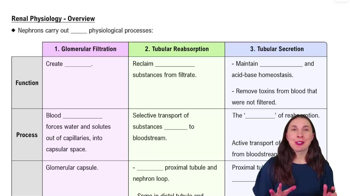
Overview of Renal Physiology

Differences in Time Scale and Mechanism

Respiratory compensation acts quickly, within minutes to hours, by changing ventilation to alter CO2 levels, while renal compensation takes hours to days, involving changes in kidney function to regulate acid-base balance. Understanding these differences is key to distinguishing their roles in maintaining homeostasis.
Recommended video:
07:58
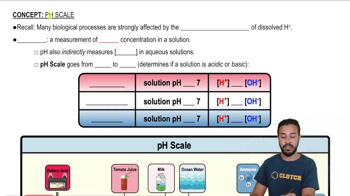
pH Scale