In Exercises 53-58, begin by graphing f(x) = log₂ x. Then use transformations of this graph to graph the given function. What is the vertical asymptote? Use the graphs to determine each function's domain and range. g(x) = (1/2)log₂ x
Table of contents
- 0. Review of Algebra4h 18m
- 1. Equations & Inequalities3h 18m
- 2. Graphs of Equations1h 43m
- 3. Functions2h 17m
- 4. Polynomial Functions1h 44m
- 5. Rational Functions1h 23m
- 6. Exponential & Logarithmic Functions2h 28m
- 7. Systems of Equations & Matrices4h 5m
- 8. Conic Sections2h 23m
- 9. Sequences, Series, & Induction1h 22m
- 10. Combinatorics & Probability1h 45m
6. Exponential & Logarithmic Functions
Introduction to Logarithms
Problem 61
Textbook Question
Graph each function. Give the domain and range. ƒ(x) = | log2 (x+3) |
Verified step by step guidance1
Identify the function given: \(f(x) = \left| \log_{2}(x+3) \right|\). This is the absolute value of a logarithmic function with base 2 and argument \((x+3)\).
Determine the domain of the function by finding the values of \(x\) for which the logarithm is defined. Since \(\log_{2}(x+3)\) requires \(x+3 > 0\), solve the inequality \(x + 3 > 0\) to get \(x > -3\). Thus, the domain is \((-3, \infty)\).
Analyze the behavior of the logarithmic function \(\log_{2}(x+3)\) before applying the absolute value. Recall that \(\log_{2}(x+3)\) is negative when \$0 < x+3 < 1\(, zero when \)x+3 = 1\(, and positive when \)x+3 > 1\(. This corresponds to \)-3 < x < -2\(, \)x = -2\(, and \)x > -2$ respectively.
Apply the absolute value to the logarithmic function. For \(x\) values where \(\log_{2}(x+3)\) is negative, the function \(f(x)\) will reflect those values above the x-axis, making them positive. For \(x\) values where \(\log_{2}(x+3)\) is zero or positive, \(f(x)\) remains the same as \(\log_{2}(x+3)\).
Determine the range of \(f(x)\). Since the absolute value makes all outputs non-negative and the logarithmic function can grow without bound positively, the range is \([0, \infty)\). To graph, plot key points such as \(x = -3\) (approaching domain boundary), \(x = -2\) (where \(f(x) = 0\)), and values greater than \(-2\) to see the increasing behavior.
Verified video answer for a similar problem:This video solution was recommended by our tutors as helpful for the problem above
Video duration:
3mPlay a video:
Was this helpful?
Key Concepts
Here are the essential concepts you must grasp in order to answer the question correctly.
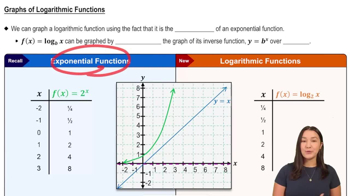
Logarithmic Functions
A logarithmic function is the inverse of an exponential function and is written as log_b(x), where b is the base. It is defined only for positive arguments (x > 0). Understanding how to evaluate and graph log functions, including their domain restrictions, is essential for analyzing ƒ(x) = |log₂(x+3)|.
Recommended video:
Graphs of Logarithmic Functions
Absolute Value Function
The absolute value function, denoted |x|, outputs the non-negative value of x, reflecting any negative inputs to positive values. When applied to a function, it affects the graph by flipping all negative outputs above the x-axis, which impacts the range and shape of ƒ(x) = |log₂(x+3)|.
Recommended video:
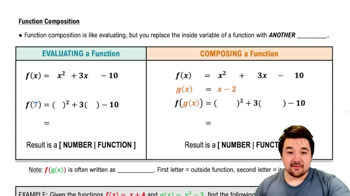
Function Composition
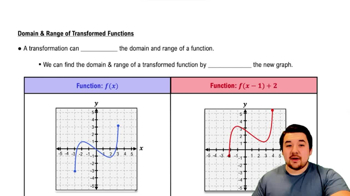
Domain and Range of Functions
The domain is the set of all input values for which the function is defined, while the range is the set of possible output values. For ƒ(x) = |log₂(x+3)|, determining the domain involves solving inequalities inside the logarithm, and the range is influenced by the absolute value transformation.
Recommended video:
Domain & Range of Transformed Functions
Watch next
Master Logarithms Introduction with a bite sized video explanation from Patrick
Start learningRelated Videos
Related Practice
Textbook Question
593
views