In Exercises 1–14, express each interval in set-builder notation and graph the interval on a number line. [- 3, 1]
Verified step by step guidance
1
Identify the given interval: \([-3, 1]\). This is a closed interval including both endpoints \(-3\) and \$1$.
Recall that set-builder notation describes the set of all elements \(x\) that satisfy a certain condition. For an interval, this condition involves inequalities.
Since the interval includes all numbers from \(-3\) to \$1$, including the endpoints, the set-builder notation uses inequalities with \leq (less than or equal to).
Write the set-builder notation as: \(\{ x \mid -3 \leq x \leq 1 \}\), which reads as "the set of all \(x\) such that \(x\) is greater than or equal to \(-3\) and less than or equal to \$1$."
To graph this interval on a number line, draw a line segment starting at \(-3\) and ending at \$1\(, with solid dots at both \)-3\( and \)1$ to indicate that these endpoints are included.
Verified video answer for a similar problem:
This video solution was recommended by our tutors as helpful for the problem above
Video duration:
1m
Play a video:
Was this helpful?
Key Concepts
Here are the essential concepts you must grasp in order to answer the question correctly.
Interval Notation
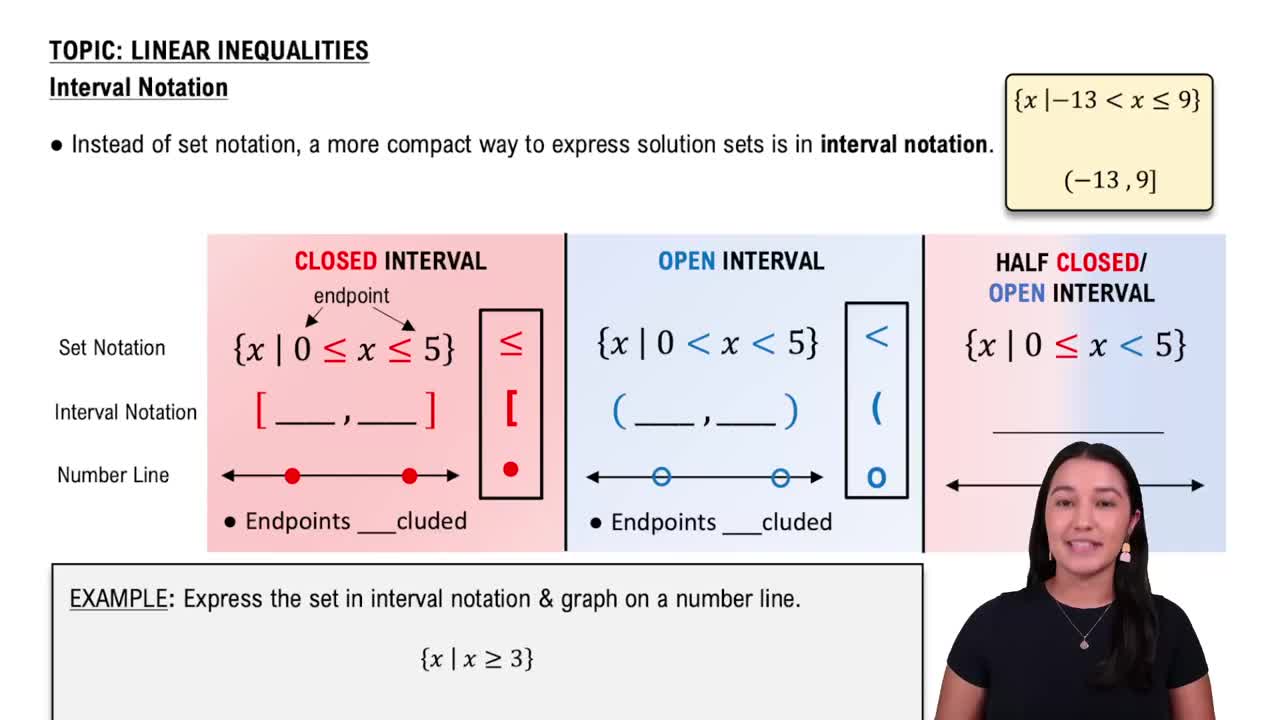
Interval notation is a way to represent a set of numbers between two endpoints. Square brackets [ ] indicate that endpoints are included (closed interval), while parentheses ( ) mean endpoints are excluded (open interval). For example, [-3, 1] includes all numbers from -3 to 1, including -3 and 1.
Set-builder notation describes a set by specifying a property that its members satisfy. For intervals, it typically uses inequalities to define the range, such as {x | -3 ≤ x ≤ 1}, meaning the set of all x such that x is between -3 and 1, inclusive.
Graphing an interval involves shading the portion of the number line that represents all numbers in the interval. Closed endpoints are shown with solid dots, indicating inclusion, while open endpoints use hollow dots, indicating exclusion. For [-3, 1], shade from -3 to 1 with solid dots at both ends.