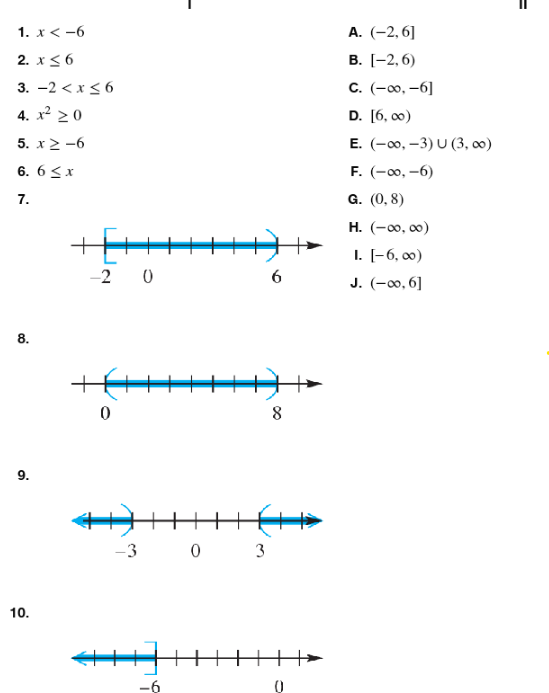
Match each equation or inequality in Column I with the graph of its solution set in Column II. | x | > 7
Table of contents
- 0. Review of Algebra4h 18m
- 1. Equations & Inequalities3h 18m
- 2. Graphs of Equations1h 43m
- 3. Functions2h 17m
- 4. Polynomial Functions1h 44m
- 5. Rational Functions1h 23m
- 6. Exponential & Logarithmic Functions2h 28m
- 7. Systems of Equations & Matrices4h 5m
- 8. Conic Sections2h 23m
- 9. Sequences, Series, & Induction1h 22m
- 10. Combinatorics & Probability1h 45m
1. Equations & Inequalities
Linear Inequalities
Problem 6
Textbook Question
Match the inequality in each exercise in Column I with its equivalent interval notation in Column II. 6≤x

Verified step by step guidance1
Identify the inequality given: \$6 \leq x\(. This means that \)x$ is greater than or equal to 6.
Recall that interval notation expresses the set of all values that satisfy the inequality using brackets and parentheses.
Since \(x\) is greater than or equal to 6, the interval starts at 6 and extends to positive infinity.
Use a square bracket \([\) to include 6 because of the 'greater than or equal to' (\(\leq\)) symbol, and use a parenthesis \()\) for infinity since infinity is not a number and cannot be included.
Write the interval notation as \([6, \infty)\) to represent all \(x\) such that \(x \geq 6\).
Verified video answer for a similar problem:This video solution was recommended by our tutors as helpful for the problem above
Video duration:
2mPlay a video:
Was this helpful?
Key Concepts
Here are the essential concepts you must grasp in order to answer the question correctly.
Inequalities
Inequalities express a relationship where one quantity is greater than, less than, or equal to another. In this case, 6 ≤ x means x is any number greater than or equal to 6. Understanding how to interpret and manipulate inequalities is essential for solving and matching them to interval notation.
Recommended video:
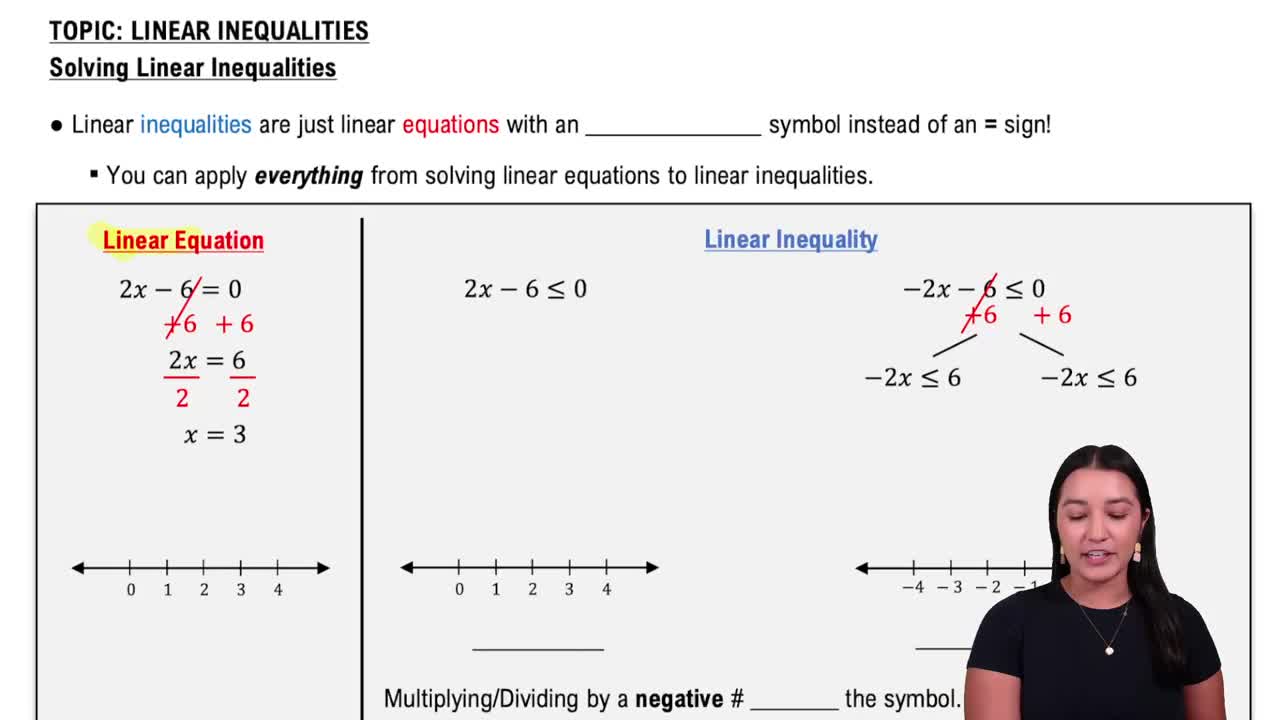
Linear Inequalities
Interval Notation
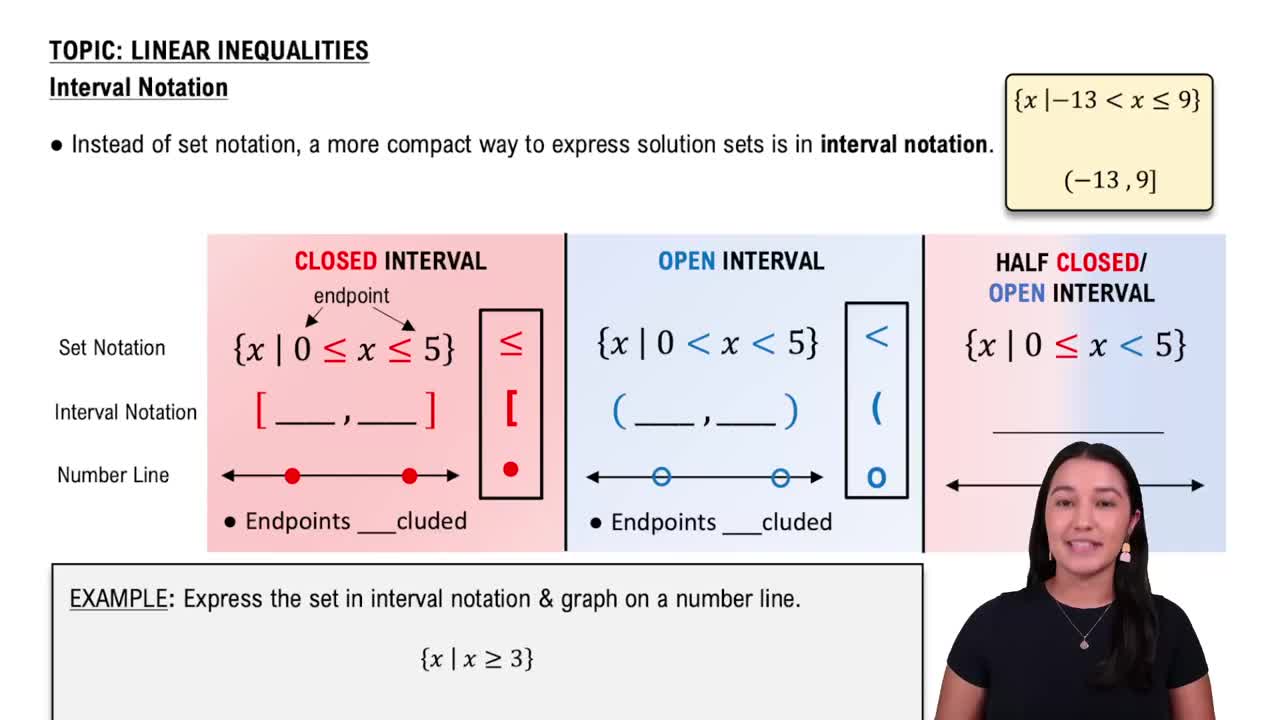
Interval notation is a concise way to represent sets of numbers between two endpoints. It uses brackets [ ] to include endpoints and parentheses ( ) to exclude them. For example, 6 ≤ x corresponds to the interval [6, ∞), indicating all numbers from 6 to infinity, including 6.
Recommended video:
Interval Notation
Set Representation of Solutions
Inequalities and interval notation both describe solution sets for variables. Recognizing how to translate between these forms helps in understanding the range of possible values. This concept involves identifying whether endpoints are included and whether the set extends infinitely or is bounded.
Recommended video:
Categorizing Linear Equations
Related Videos
Related Practice
Textbook Question
723
views