Solve each equation. (2x+1)(x-4) = x
Table of contents
- 0. Review of Algebra4h 18m
- 1. Equations & Inequalities3h 18m
- 2. Graphs of Equations1h 43m
- 3. Functions2h 17m
- 4. Polynomial Functions1h 44m
- 5. Rational Functions1h 23m
- 6. Exponential & Logarithmic Functions2h 28m
- 7. Systems of Equations & Matrices4h 5m
- 8. Conic Sections2h 23m
- 9. Sequences, Series, & Induction1h 22m
- 10. Combinatorics & Probability1h 45m
1. Equations & Inequalities
The Square Root Property
Problem 43
Textbook Question
Height of a Projectile A projectile is launched from ground level with an initial velocity of v0 feet per second. Neglecting air resistance, its height in feet t seconds after launch is given by s=-16t2+v0t. In each exercise, find the time(s) that the projectile will (a) reach a height of 80 ft and (b) return to the ground for the given value of v0. Round answers to the nearest hundredth if necessary. v0=96
Verified step by step guidance1
Start with the given height function for the projectile: \(s = -16t^2 + v_0 t\), where \(v_0 = 96\) feet per second. Substitute \(v_0\) into the equation to get \(s = -16t^2 + 96t\).
For part (a), set the height \(s\) equal to 80 feet to find the time(s) when the projectile reaches this height: \(-16t^2 + 96t = 80\).
Rearrange the equation to standard quadratic form: \(-16t^2 + 96t - 80 = 0\). You can simplify this equation by dividing all terms by -16 to make calculations easier.
Solve the quadratic equation for \(t\) using the quadratic formula: \(t = \frac{-b \pm \sqrt{b^2 - 4ac}}{2a}\), where \(a\), \(b\), and \(c\) are the coefficients from the quadratic equation.
For part (b), find the time when the projectile returns to the ground by setting \(s = 0\) and solving \(-16t^2 + 96t = 0\). Factor the equation and solve for \(t\) to find the time(s) when the height is zero.
Verified video answer for a similar problem:This video solution was recommended by our tutors as helpful for the problem above
Video duration:
7mPlay a video:
Was this helpful?
Key Concepts
Here are the essential concepts you must grasp in order to answer the question correctly.
Quadratic Functions and Their Graphs
A quadratic function is a polynomial of degree two, typically written as s(t) = at^2 + bt + c. Its graph is a parabola, which opens upward if a > 0 and downward if a < 0. In projectile motion, the height function is quadratic, modeling the path of the projectile over time.
Recommended video:
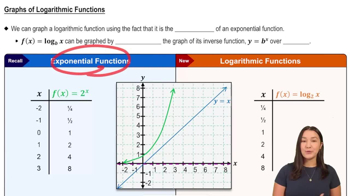
Graphs of Logarithmic Functions
Solving Quadratic Equations
To find specific times when the projectile reaches a certain height, you solve the quadratic equation s(t) = given height. This involves rearranging the equation to standard form and using methods like factoring, completing the square, or the quadratic formula to find real solutions for t.
Recommended video:
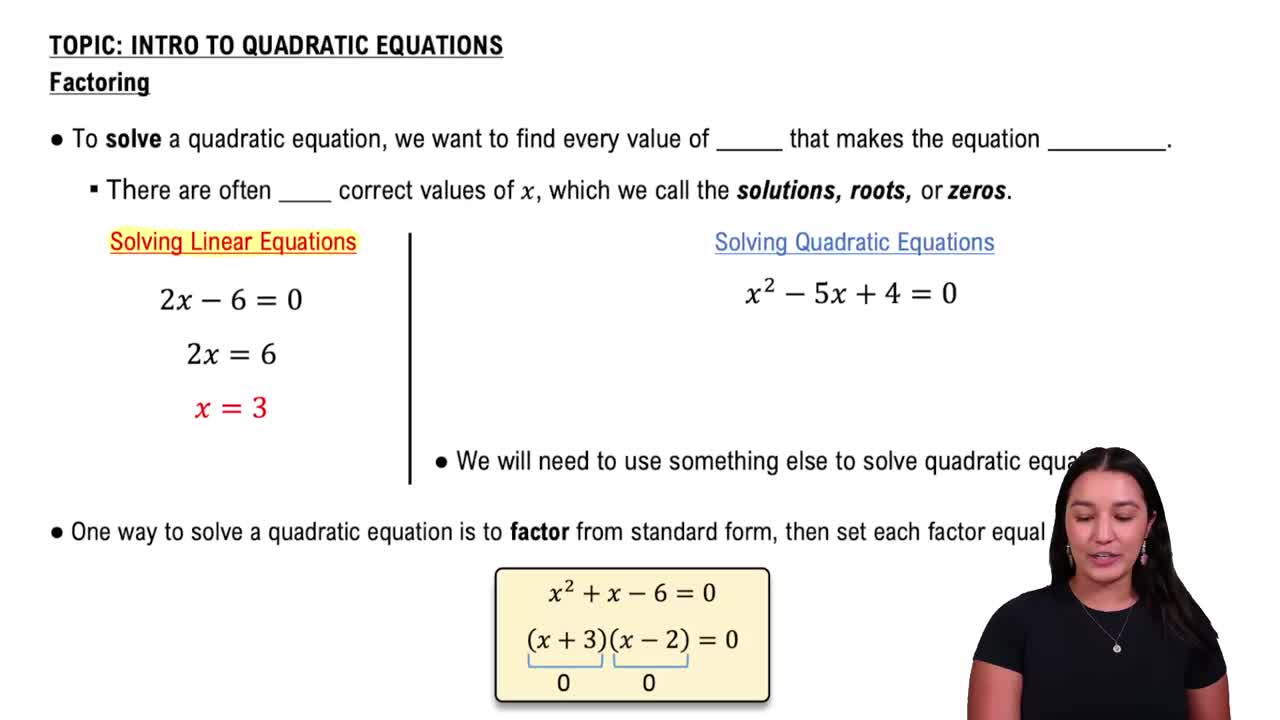
Solving Quadratic Equations by Factoring
Interpreting Solutions in Context
The solutions to the quadratic equation represent times when the projectile is at a certain height. Positive real solutions correspond to meaningful times after launch, while negative or complex solutions are not physically relevant. Understanding this helps identify when the projectile reaches a height or returns to the ground.
Recommended video:
Probability of Non-Mutually Exclusive Events Example
Watch next
Master Solving Quadratic Equations by the Square Root Property with a bite sized video explanation from Patrick
Start learningRelated Videos
Related Practice
Textbook Question
646
views