When 4 times a number is subtracted from 5, the absolute value of the difference is at most 13. Use interval notation to express the set of all numbers that satisfy this condition.
Verified step by step guidance
1
Start by translating the problem into a mathematical inequality. Let the unknown number be represented by \( x \). The phrase '4 times a number is subtracted from 5' can be written as \( 5 - 4x \). The absolute value of this expression is given as \( |5 - 4x| \), and the condition 'is at most 13' translates to \( |5 - 4x| \leq 13 \).
To solve the absolute value inequality \( |5 - 4x| \leq 13 \), rewrite it as a compound inequality: \( -13 \leq 5 - 4x \leq 13 \). This step removes the absolute value by considering both the positive and negative cases.
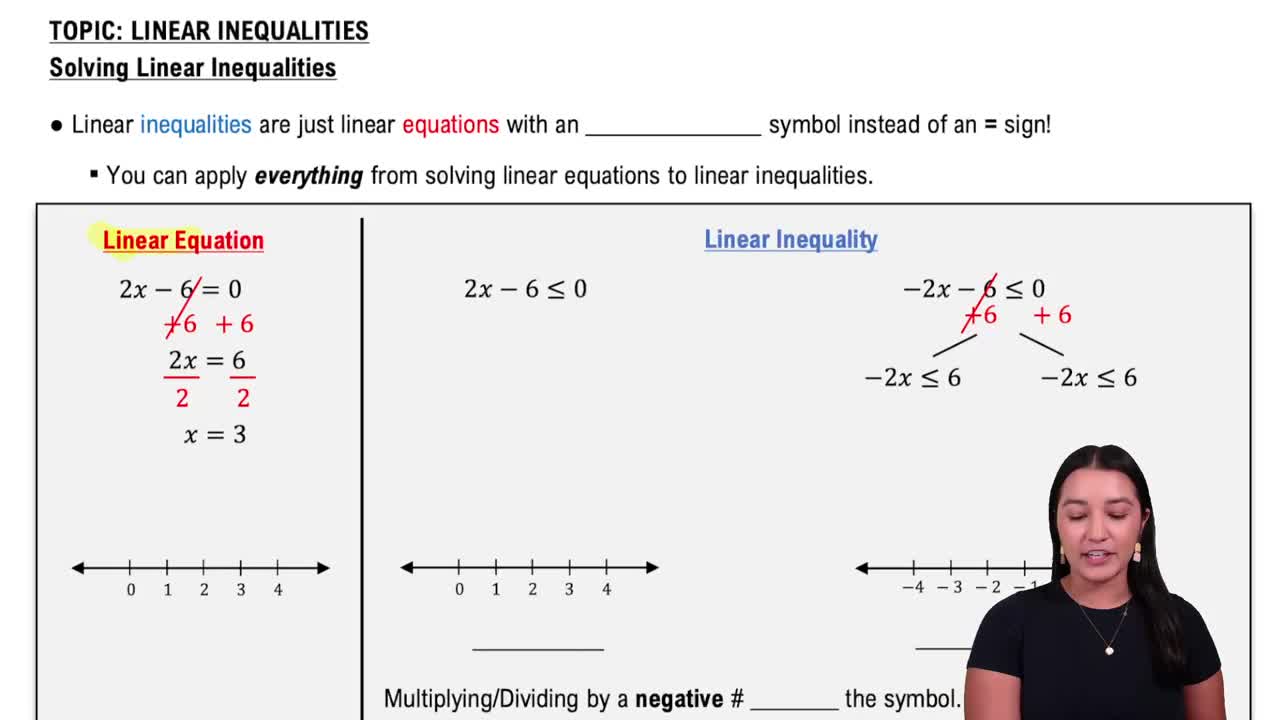
Solve the compound inequality \( -13 \leq 5 - 4x \leq 13 \) by isolating \( x \). Start by subtracting 5 from all parts of the inequality: \( -13 - 5 \leq -4x \leq 13 - 5 \), which simplifies to \( -18 \leq -4x \leq 8 \).
Next, divide through by \( -4 \) to isolate \( x \). Remember that dividing by a negative number reverses the inequality signs: \( \frac{-18}{-4} \geq x \geq \frac{8}{-4} \). Simplify the fractions to get \( 4.5 \geq x \geq -2 \), or equivalently \( -2 \leq x \leq 4.5 \).
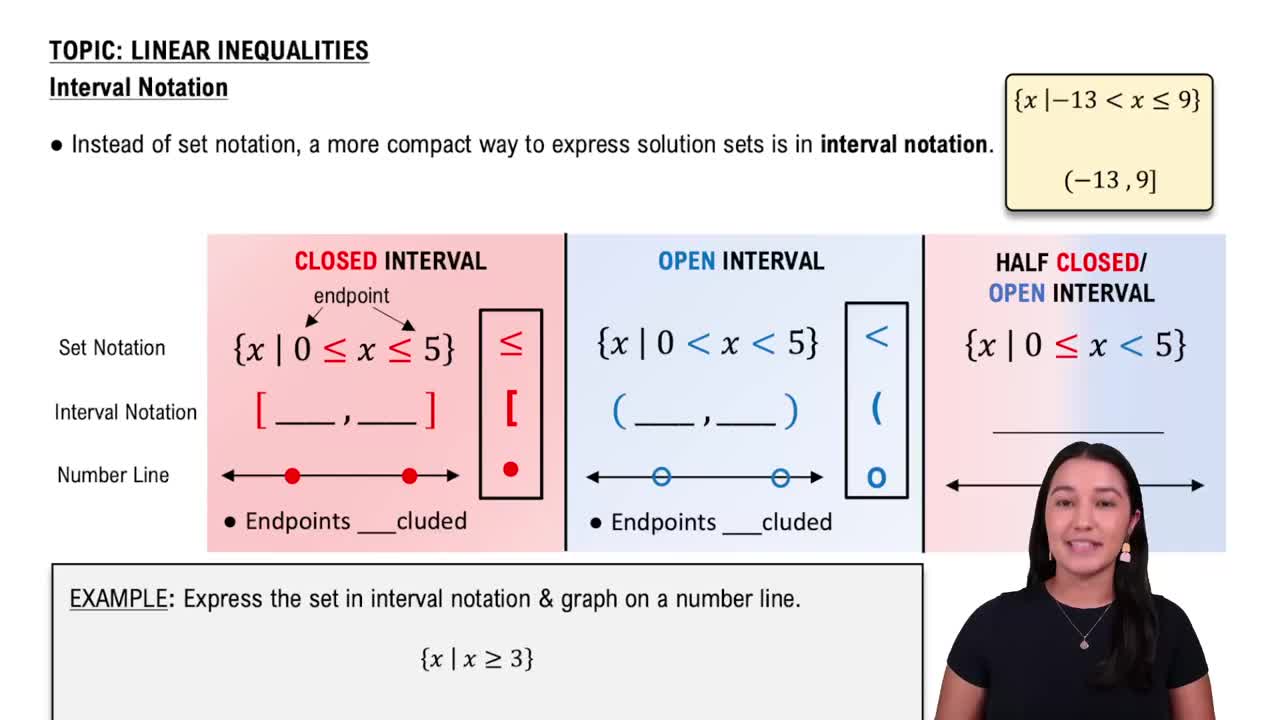
Express the solution in interval notation. The set of all numbers \( x \) that satisfy the inequality is \( [-2, 4.5] \).
Verified video answer for a similar problem:
This video solution was recommended by our tutors as helpful for the problem above
Video duration:
4m
Play a video:
Was this helpful?
Key Concepts
Here are the essential concepts you must grasp in order to answer the question correctly.
Absolute Value
Absolute value measures the distance of a number from zero on the number line, regardless of direction. It is denoted as |x|, where |x| = x if x is positive or zero, and |x| = -x if x is negative. In this problem, the absolute value indicates that the difference between 5 and 4 times a number can vary within a specific range.
Inequalities express a relationship where one quantity is larger or smaller than another. In this case, the condition states that the absolute value of the difference must be at most 13, which translates to a double inequality. Understanding how to manipulate and solve inequalities is crucial for finding the solution set.
Interval notation is a mathematical notation used to represent a range of values. It uses parentheses and brackets to indicate whether endpoints are included (closed interval) or excluded (open interval). In this problem, once the solution set is determined, interval notation will succinctly express all numbers that satisfy the given condition.