Use interval notation to represent all values of x satisfying the given conditions. y = 2x - 11 + 3(x + 2) and y is at most 0
Table of contents
- 0. Review of Algebra4h 18m
- 1. Equations & Inequalities3h 18m
- 2. Graphs of Equations1h 43m
- 3. Functions2h 17m
- 4. Polynomial Functions1h 44m
- 5. Rational Functions1h 23m
- 6. Exponential & Logarithmic Functions2h 28m
- 7. Systems of Equations & Matrices4h 5m
- 8. Conic Sections2h 23m
- 9. Sequences, Series, & Induction1h 22m
- 10. Combinatorics & Probability1h 45m
1. Equations & Inequalities
Linear Inequalities
Problem 102a
Textbook Question
Use interval notation to represent all values of x satisfying the given conditions. y = 8 - |5x + 3| and y is at least 6
Verified step by step guidance1
Step 1: Start by understanding the inequality. The problem states that y = 8 - |5x + 3| and y is at least 6. This means we need to solve the inequality 8 - |5x + 3| ≥ 6.
Step 2: Isolate the absolute value expression. Subtract 6 from both sides of the inequality: 8 - |5x + 3| - 6 ≥ 0, which simplifies to 2 - |5x + 3| ≥ 0.
Step 3: Rearrange the inequality to isolate the absolute value term. Subtract 2 from both sides: -|5x + 3| ≥ -2. Then multiply through by -1 (remember to reverse the inequality sign when multiplying by a negative): |5x + 3| ≤ 2.
Step 4: Solve the absolute value inequality. Recall that |A| ≤ B implies -B ≤ A ≤ B. Apply this to the expression |5x + 3| ≤ 2: -2 ≤ 5x + 3 ≤ 2.
Step 5: Solve the compound inequality for x. First, subtract 3 from all parts: -2 - 3 ≤ 5x ≤ 2 - 3, which simplifies to -5 ≤ 5x ≤ -1. Then divide through by 5: -1 ≤ x ≤ -1/5. Represent this solution in interval notation as [-1, -1/5].
Verified video answer for a similar problem:This video solution was recommended by our tutors as helpful for the problem above
Video duration:
4mPlay a video:
Was this helpful?
Key Concepts
Here are the essential concepts you must grasp in order to answer the question correctly.
Absolute Value Function
The absolute value function, denoted as |x|, represents the distance of x from zero on the number line, always yielding a non-negative result. In the context of the given equation, |5x + 3| indicates that the expression inside the absolute value can take on both positive and negative values, affecting the overall equation's solutions.
Recommended video:
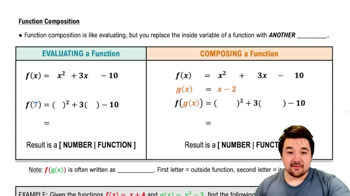
Function Composition
Inequalities
Inequalities express a relationship where one side is not necessarily equal to the other, using symbols like '≥' or '<'. In this problem, the condition 'y is at least 6' translates to the inequality y ≥ 6, which will guide the determination of the values of x that satisfy the equation when combined with the absolute value expression.
Recommended video:
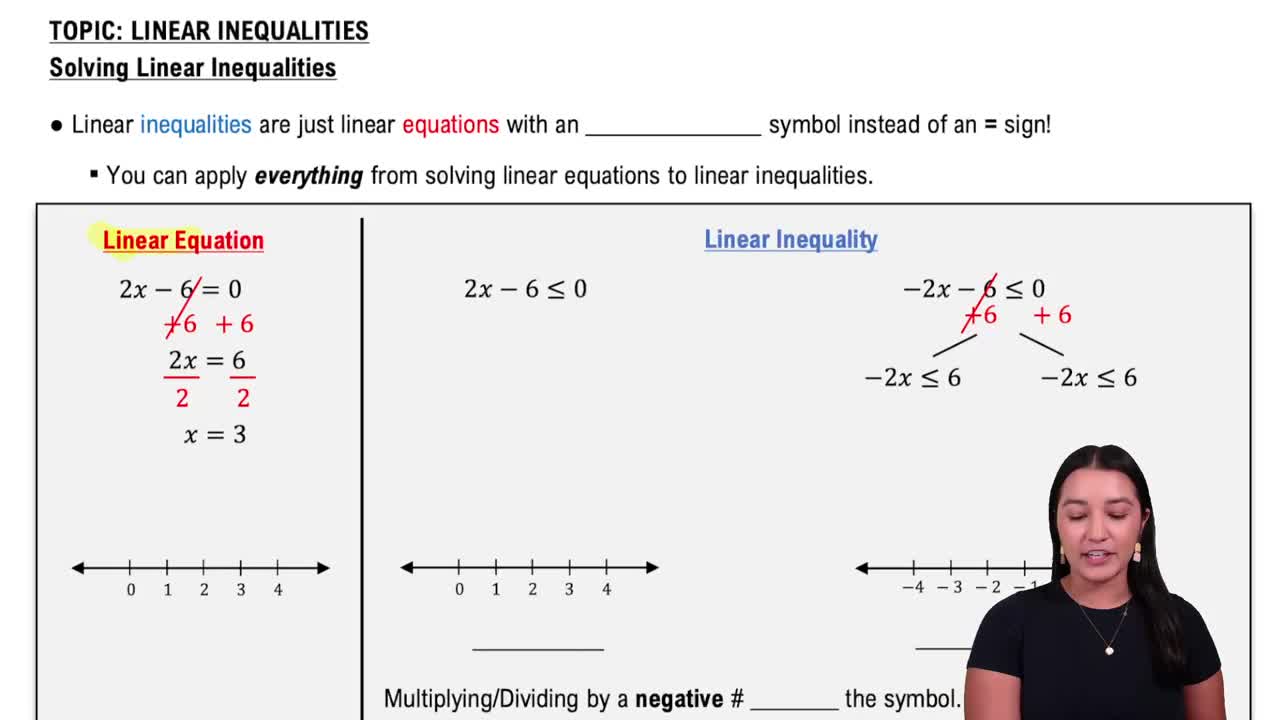
Linear Inequalities
Interval Notation
Interval notation is a mathematical notation used to represent a range of values on the number line. It uses brackets [ ] for inclusive endpoints and parentheses ( ) for exclusive endpoints. Understanding how to convert the solutions from inequalities into interval notation is crucial for clearly expressing the set of x values that meet the specified conditions.
Recommended video:
Interval Notation
Related Videos
Related Practice
Textbook Question
613
views