In Exercises 95–98, use long division to rewrite the equation for g in the form quotient + remainder/divisor. Then use this form of the function's equation and transformations of f(x) = 1/x to graph g. g(x)=(3x−7)/(x−2)
Table of contents
- 0. Review of Algebra4h 18m
- 1. Equations & Inequalities3h 18m
- 2. Graphs of Equations1h 43m
- 3. Functions2h 17m
- 4. Polynomial Functions1h 44m
- 5. Rational Functions1h 23m
- 6. Exponential & Logarithmic Functions2h 28m
- 7. Systems of Equations & Matrices4h 5m
- 8. Conic Sections2h 23m
- 9. Sequences, Series, & Induction1h 22m
- 10. Combinatorics & Probability1h 45m
5. Rational Functions
Graphing Rational Functions
Struggling with College Algebra?
Join thousands of students who trust us to help them ace their exams!Watch the first videoMultiple Choice
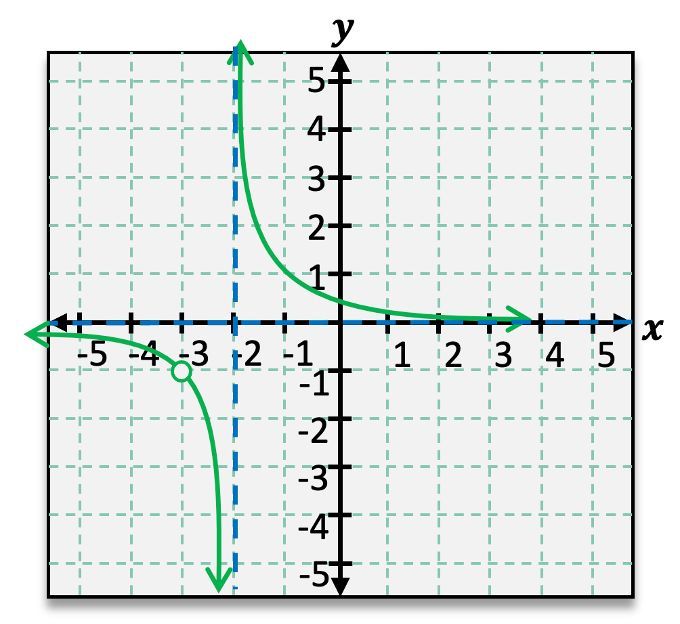
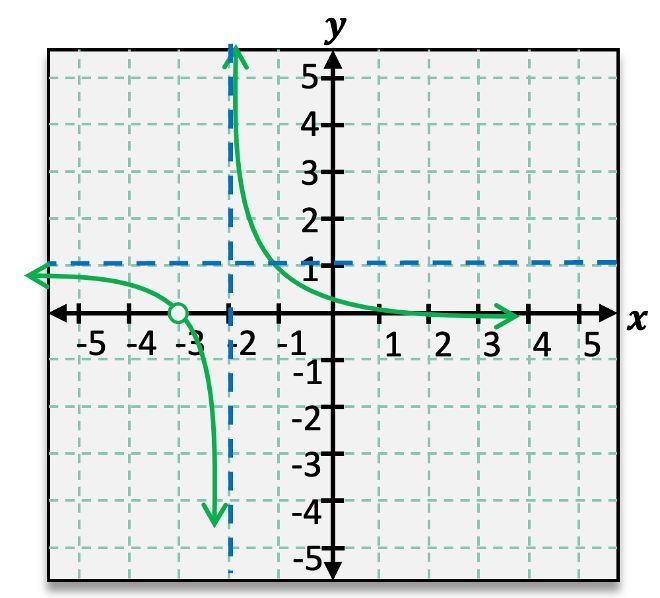
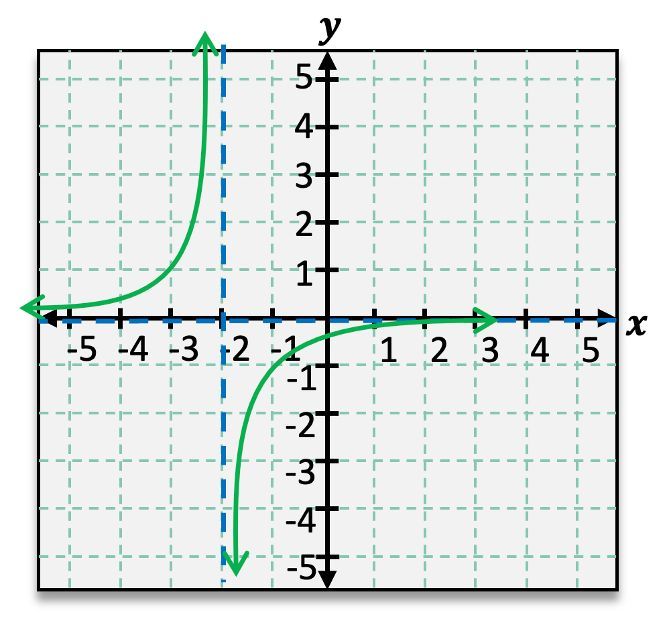
Graph the rational function.
f(x)=x2+5x+6x+3
A
B
C
D
Verified step by step guidance1
Identify the rational function: \( f(x) = \frac{x+3}{x^2+5x+6} \).
Factor the denominator: \( x^2 + 5x + 6 = (x+2)(x+3) \).
Determine the vertical asymptotes by setting the denominator equal to zero: \( x+2=0 \) and \( x+3=0 \), giving \( x = -2 \) and \( x = -3 \).
Find the horizontal asymptote by comparing the degrees of the numerator and denominator. Since the degree of the numerator (1) is less than the degree of the denominator (2), the horizontal asymptote is \( y = 0 \).
Identify any holes in the graph by checking for common factors in the numerator and denominator. Since \( x+3 \) is a common factor, there is a hole at \( x = -3 \).
Watch next
Master Graphing Rational Functions Using Transformations with a bite sized video explanation from Patrick
Start learningRelated Videos
Related Practice
Textbook Question
415
views
Graphing Rational Functions practice set

