Give a rule for each piecewise-defined function. Also give the domain and range.
Verified step by step guidance
1
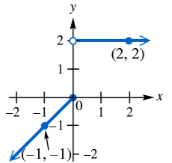
Step 1: Identify the two pieces of the piecewise function from the graph. The first piece is a line passing through points (-3, 12), (-2, 8), and (0, 0). The second piece is a horizontal line starting at (0, -5) and extending to the right.
Step 2: Find the equation of the first piece (the line through (-3, 12), (-2, 8), and (0, 0)). Calculate the slope using two points, for example, slope = (8 - 12) / (-2 + 3) = -4 / 1 = -4. Since the line passes through (0, 0), the y-intercept is 0. So, the equation is \(y = -4x\).
Step 3: Write the domain for the first piece. From the graph, this piece is defined for \(x \leq 0\) because it ends at (0, 0).
Step 4: Write the equation for the second piece. It is a horizontal line at \(y = -5\) starting at \(x = 0\) and extending to the right, so the equation is \(y = -5\).
Step 5: Write the domain for the second piece as \(x > 0\) because the point at (0, -5) is open (not included), and the line extends to the right. Finally, determine the range by combining the y-values from both pieces: the first piece ranges from 0 to 12 (since it goes from (0,0) up to (-3,12)) and the second piece is constant at -5.
Verified video answer for a similar problem:
This video solution was recommended by our tutors as helpful for the problem above
Video duration:
7m
Play a video:
Was this helpful?
Key Concepts
Here are the essential concepts you must grasp in order to answer the question correctly.
Piecewise-Defined Functions
A piecewise-defined function is a function composed of multiple sub-functions, each applying to a specific interval of the domain. Understanding how to write rules for each piece based on the graph or description is essential for defining the function accurately.
The domain of a function is the set of all possible input values (x-values), while the range is the set of all possible output values (y-values). Identifying these from a graph involves noting the intervals covered on the x-axis and the corresponding y-values.
Reading a graph involves understanding points, open and closed circles, and line segments. Closed circles indicate the point is included in the function, while open circles mean the point is excluded. This helps in defining the function's pieces and their domains precisely.