Identify the given function: \(f(x) = -2(x - 1)^2 (x + 3)\). This is a polynomial function expressed in factored form.
Find the zeros (roots) of the function by setting each factor equal to zero: solve \((x - 1)^2 = 0\) and \((x + 3) = 0\) to find the x-intercepts.
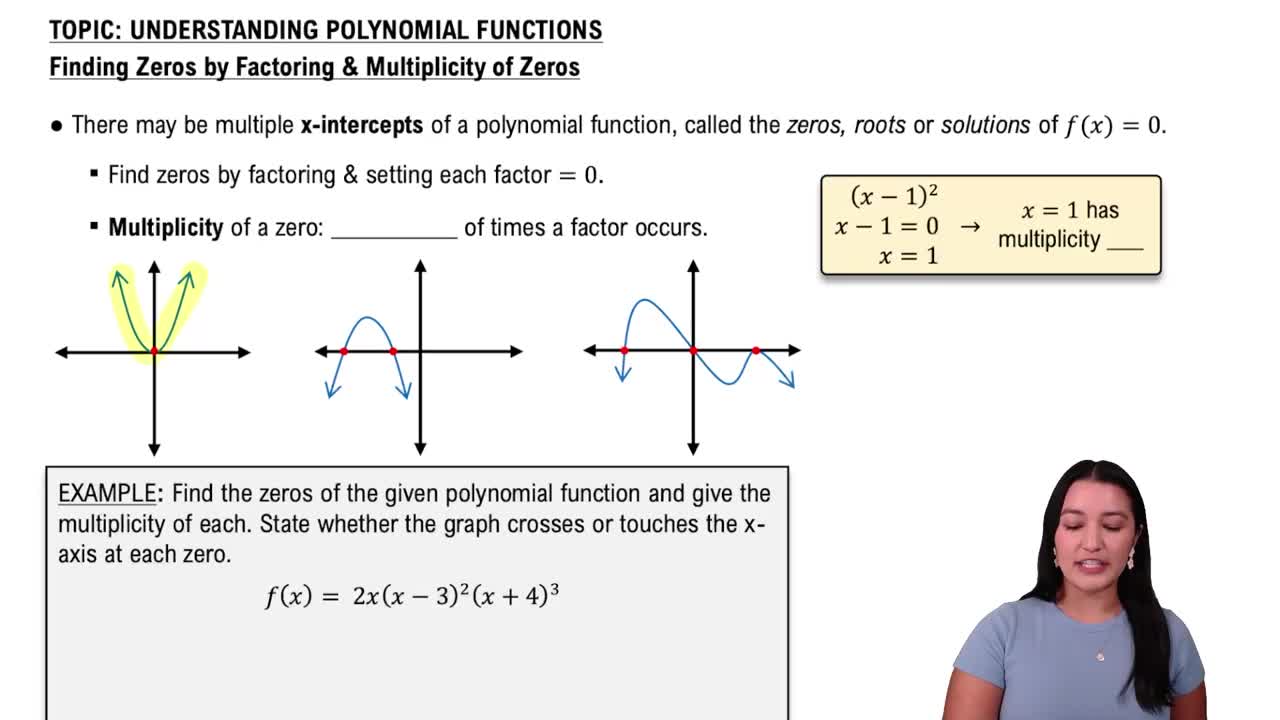
Determine the multiplicity of each zero: the zero at \(x = 1\) has multiplicity 2 (because of the squared factor), and the zero at \(x = -3\) has multiplicity 1.
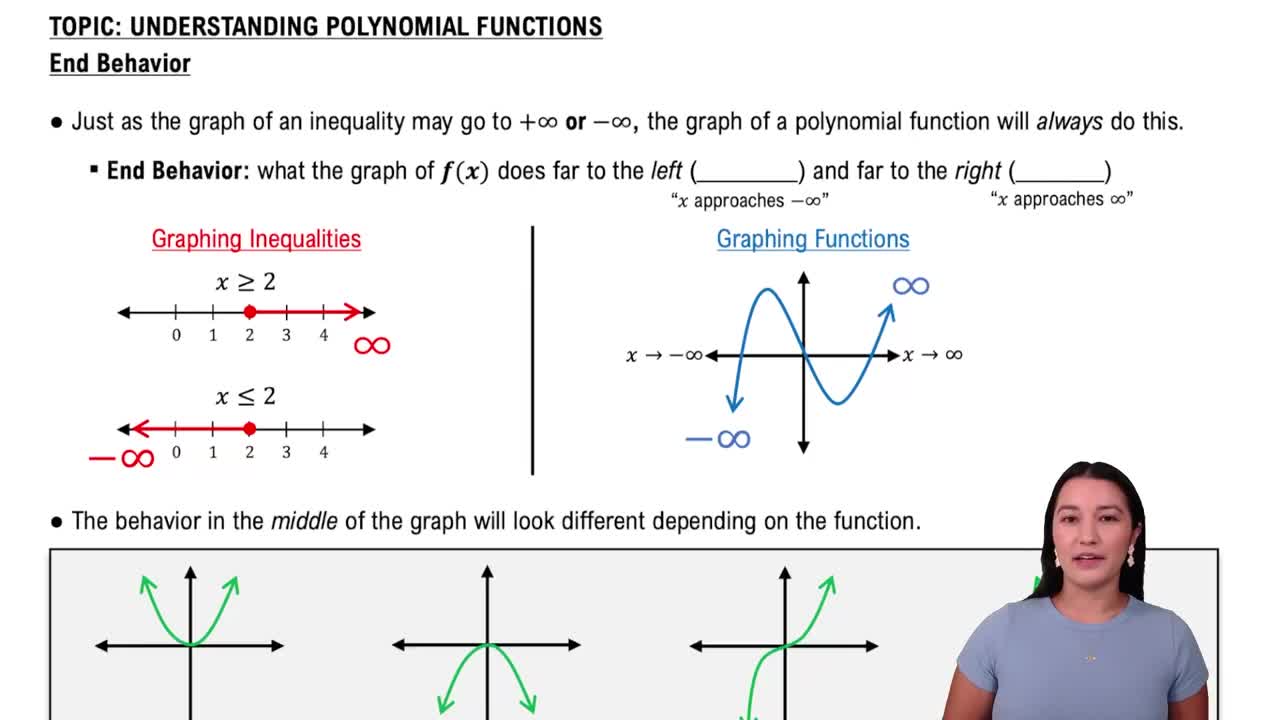
Analyze the end behavior of the polynomial by looking at the leading term. First, expand the factors to find the leading term or consider the degree and leading coefficient: the degree is 3 and the leading coefficient is negative.
Use the zeros, their multiplicities, and the end behavior to sketch the graph: the graph touches and turns around at \(x=1\) (due to even multiplicity) and crosses the x-axis at \(x=-3\) (due to odd multiplicity), with the ends going in opposite directions because of the negative leading coefficient.
0 Comments
Key Concepts
Here are the essential concepts you must grasp in order to answer the question correctly.
Polynomial Function Structure
A polynomial function is an expression consisting of variables raised to whole-number exponents and their coefficients. Understanding the degree and terms of the polynomial helps in analyzing its shape and behavior. In this case, f(x) = -2(x − 1)²(x + 3) is a cubic polynomial with roots at x = 1 and x = -3.
The zeros of a polynomial are the values of x that make the function equal to zero. The multiplicity of a zero indicates how many times that root is repeated, affecting the graph's behavior at that point. Here, x = 1 is a root with multiplicity 2, causing the graph to touch and turn at this root, while x = -3 is a root with multiplicity 1, where the graph crosses the x-axis.
End behavior describes how the graph behaves as x approaches positive or negative infinity, determined by the leading term's degree and coefficient. For f(x) = -2(x − 1)²(x + 3), the leading term is negative and cubic, so as x → ∞, f(x) → -∞, and as x → -∞, f(x) → ∞. This helps predict the overall shape of the graph.

 Verified step by step guidance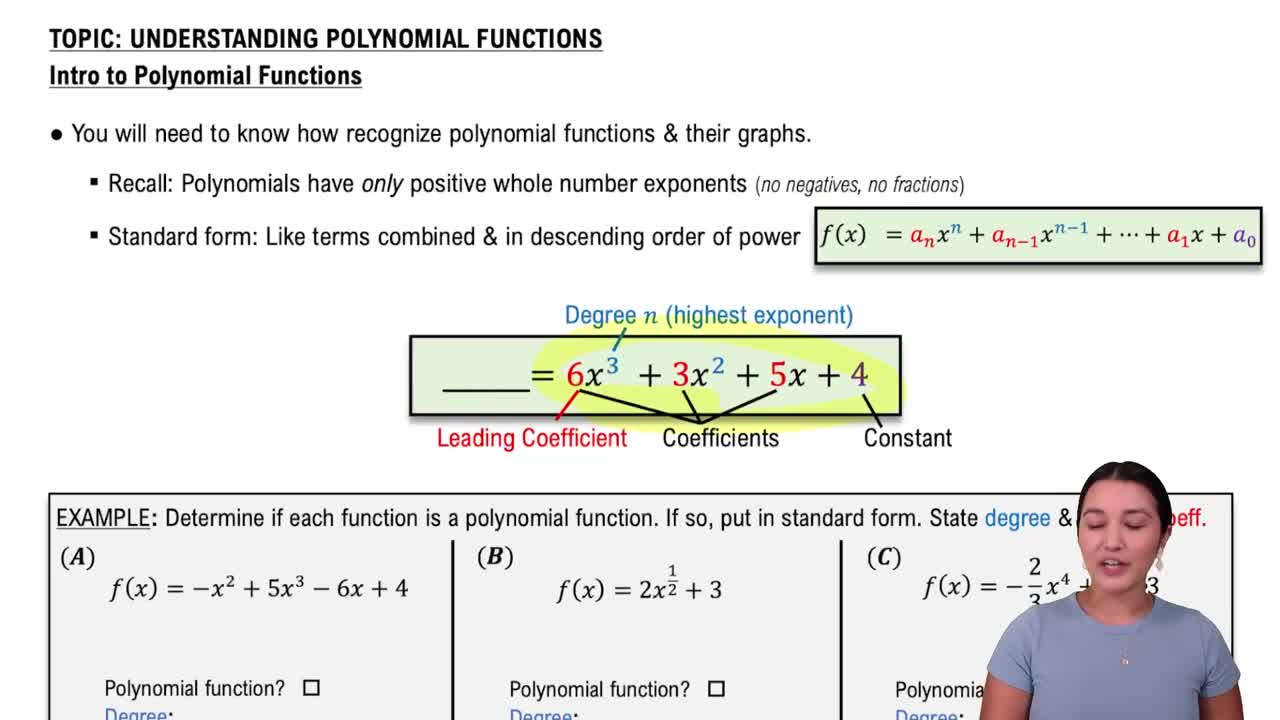
 06:04
06:04