Exercises 107–109 will help you prepare for the material covered in the next section. Determine whether f(x)=x4−2x2+1 is even, odd, or neither. Describe the symmetry, if any, for the graph of f.
Table of contents
- 0. Review of Algebra4h 18m
- 1. Equations & Inequalities3h 18m
- 2. Graphs of Equations1h 43m
- 3. Functions2h 17m
- 4. Polynomial Functions1h 44m
- 5. Rational Functions1h 23m
- 6. Exponential & Logarithmic Functions2h 28m
- 7. Systems of Equations & Matrices4h 5m
- 8. Conic Sections2h 23m
- 9. Sequences, Series, & Induction1h 22m
- 10. Combinatorics & Probability1h 45m
4. Polynomial Functions
Understanding Polynomial Functions
Problem 21
Textbook Question
Graph the following on the same coordinate system.
(a) y = (x - 2)2
(b) y = (x + 1)2
(c) y = (x + 3)2
(d) How do these graphs differ from the graph of y = x2?
Verified step by step guidance1
Identify the base graph, which is the parent function \(y = x^{2}\). This is a parabola with its vertex at the origin \((0,0)\) and opens upward.
For each given function, recognize that they are transformations of the parent function involving horizontal shifts. Specifically, \(y = (x - 2)^{2}\) shifts the graph of \(y = x^{2}\) to the right by 2 units.
Similarly, \(y = (x + 1)^{2}\) shifts the graph of \(y = x^{2}\) to the left by 1 unit, and \(y = (x + 3)^{2}\) shifts it to the left by 3 units.
To graph each function, plot the vertex at the shifted point: \((2,0)\) for \(y = (x - 2)^{2}\), \((-1,0)\) for \(y = (x + 1)^{2}\), and \((-3,0)\) for \(y = (x + 3)^{2}\). Then sketch the parabola opening upward from each vertex.
In summary, these graphs differ from \(y = x^{2}\) by horizontal translations. The shape and orientation remain the same, but the vertex moves left or right depending on the sign and value inside the parentheses.
Was this helpful?
Key Concepts
Here are the essential concepts you must grasp in order to answer the question correctly.
Graphing Quadratic Functions
Quadratic functions are represented by equations of the form y = ax² + bx + c. Their graphs are parabolas, which are U-shaped curves. Understanding how to plot points and identify the vertex helps in sketching these graphs accurately.
Recommended video:
Graphs of Logarithmic Functions
Horizontal Shifts of Parabolas
The expressions (x - h)² represent horizontal shifts of the basic parabola y = x². If h is positive, the graph shifts h units to the right; if h is negative, it shifts |h| units to the left. This shift changes the vertex position without altering the shape.
Recommended video:
Horizontal Parabolas
Vertex Form of a Quadratic Function
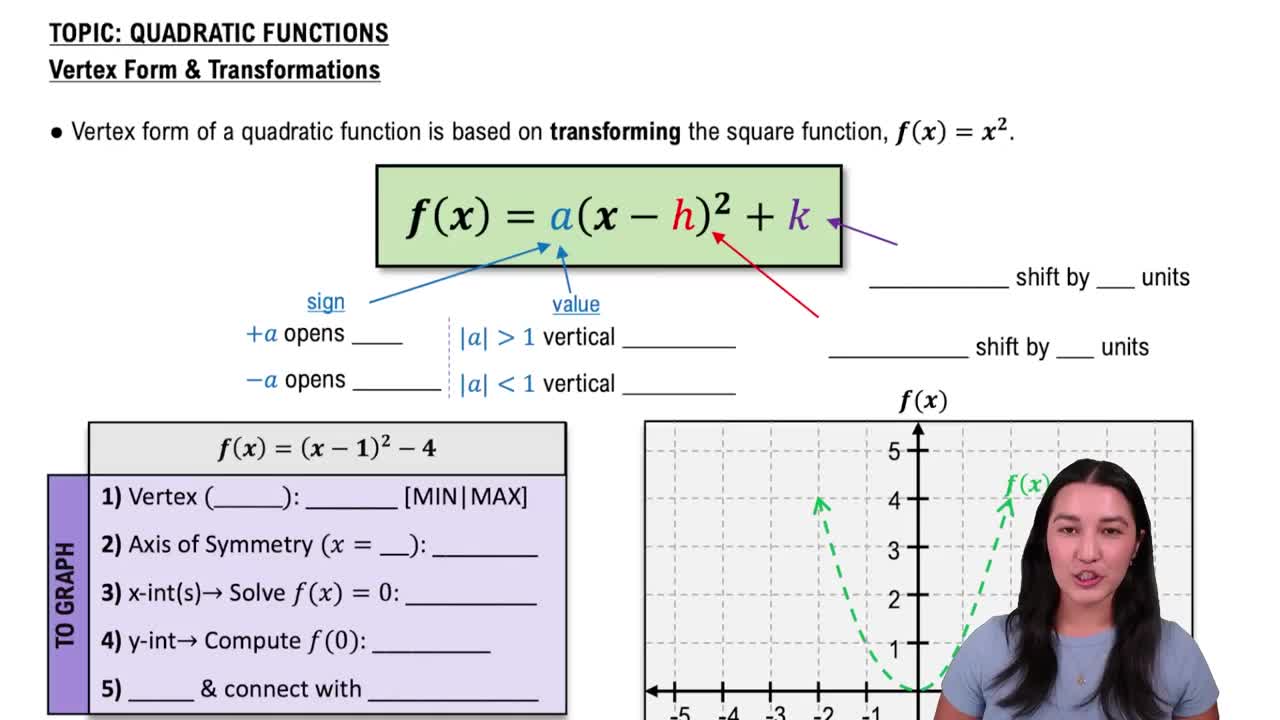
The vertex form y = (x - h)² shows the parabola's vertex at (h, 0). This form makes it easy to identify the vertex and understand transformations like shifts. Comparing graphs in vertex form reveals how each parabola moves relative to y = x².
Recommended video:
Vertex Form
Watch next
Master Introduction to Polynomial Functions with a bite sized video explanation from Patrick
Start learningRelated Videos
Related Practice
Textbook Question
676
views