Capital Expenditures Budget: Videos & Practice Problems
A Capital Expenditures Budget tracks large, irregular purchases that are important to the business but are not included in the regular operating or product cost budgets. These capital expenditures usually involve major equipment and other long-term assets that are not bought every quarter, yet can have a significant effect on the company’s cash balance when they occur.
This budget is built from management forecasts about expected major purchases rather than from the standard budget schedules. It lists the timing and amount of each planned purchase by period and then totals those amounts for the year. In practice, the schedule may be simple when only one asset purchase is expected, or much more detailed when many items of equipment must be replaced or acquired.
The main purpose of the Capital Expenditures Budget is to identify future cash disbursements tied to major asset purchases so they can be included in the broader cash budget. By separating regular costs from irregular equipment spending, the company can better plan for the cash impact of a new kiln, forklift, or similar major asset acquisition.
Capital Expenditures Budget

Capital Expenditures Budget
A furniture maker has set the following budgeted Unit Sales for the coming three months:
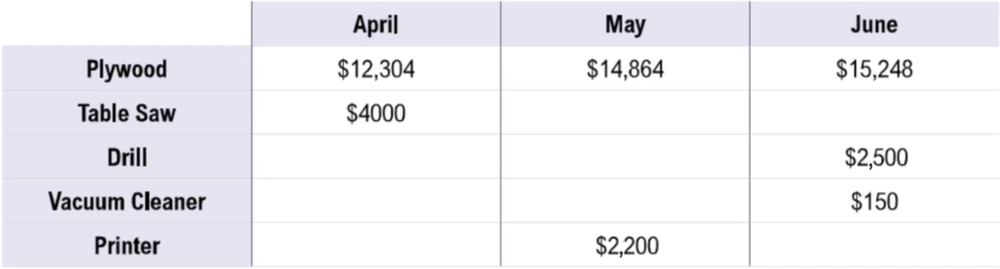
The variable operating expense is \$2.50 per unit with fixed monthly operating expenses of \$1,000 for rent, \$3,500 for staff salaries, and \$1,200 for depreciation. Calculate the operating expense budget for the month of May.
\$14,864
\$0
\$2,200
\$17,064
Here's what students ask on this topic:
A capital expenditures budget is a financial plan that tracks large, irregular purchases of long-term assets, such as major equipment, that a business does not buy regularly. These purchases are important because they can significantly impact the company's cash balance but are not included in regular operating or product cost budgets. The budget helps the business plan for these large cash outflows by forecasting when and how much will be spent on such assets. This allows the company to manage its cash flow better and ensure it has enough funds available when these big purchases occur, supporting the company’s long-term success.
The capital expenditures budget differs from operating expenses and product cost budgets because it focuses on irregular, large purchases of long-term assets, rather than regular, ongoing costs. Operating expenses cover day-to-day costs like salaries and utilities, while product cost budgets include costs directly related to producing goods. Capital expenditures are not frequent and involve significant investments, such as buying a kiln or forklift. This budget is based on management forecasts rather than routine expenses, and it helps plan for cash disbursements that are not captured in other budgets.
Companies determine what to include in their capital expenditures budget by consulting management forecasts about expected major purchases. These forecasts identify large, irregular expenses such as new equipment or machinery needed for operations. For example, a pottery company might include the cost of a new kiln or forklift. The budget lists the timing and amount of each planned purchase by period, allowing the company to prepare for these cash outflows. This information usually comes from key personnel responsible for asset management, ensuring the budget reflects actual future needs.
The capital expenditures budget directly affects the cash budget because it identifies large cash disbursements for major asset purchases that are not included in other budgets. When a company plans to buy expensive equipment, such as a kiln, the capital expenditures budget shows when the cash will be spent and how much. This information is then incorporated into the cash budget to provide a complete picture of cash inflows and outflows. By including capital expenditures, the cash budget helps the company ensure it has sufficient cash available to cover these significant payments without disrupting daily operations.
A capital expenditures budget can be either simple or complex depending on the number and size of planned asset purchases. If a company only expects to buy one or two major items, like a single kiln, the budget will be straightforward with just a few entries. However, for larger companies with many pieces of equipment to replace or acquire irregularly, the budget can have dozens or even hundreds of rows detailing each purchase. The complexity is influenced by the scale of operations and the frequency of capital asset needs, requiring more detailed planning and forecasting.

