Ch. 12 - Characterizing and Classifying Eukaryotes
Bauman - Microbiology with Diseases by Taxonomy 6th Edition
Bauman6th EditionMicrobiology with Diseases by TaxonomyISBN: 9780134832302Not the one you use?Change textbook
Chapter 12, Problem 12

Amoebas include microbes with _________.
a. Threadlike pseudopods
b. Eyespots
c. Parabasal bodies
d. Alveoli

Verified step by step guidance
1
Understand the question is asking about a characteristic feature of amoebas, specifically what type of cellular structure or organelle they possess.
Recall that amoebas are a type of protozoan known for their movement and feeding method using extensions of their cytoplasm called pseudopods.
Identify the types of pseudopods: amoebas typically have 'lobose' or 'threadlike' pseudopods, which help them move and engulf food.
Review the other options: eyespots are found in some algae, parabasal bodies are associated with certain flagellates like Trichomonas, and alveoli are membrane-bound sacs found in alveolates such as ciliates and dinoflagellates.
Conclude that the correct feature associated with amoebas is 'threadlike pseudopods' based on their mode of locomotion and feeding.

Verified video answer for a similar problem:

This video solution was recommended by our tutors as helpful for the problem above.
Video duration:
1m
Was this helpful?

Key Concepts

Here are the essential concepts you must grasp in order to answer the question correctly.

Pseudopods in Amoebas

Amoebas move and capture food using pseudopods, which are temporary, threadlike or lobed extensions of their cytoplasm. These structures allow amoebas to perform amoeboid movement and engulf prey through phagocytosis.
Recommended video:
Guided course
02:24
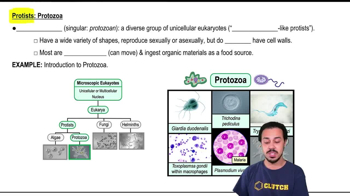
Protists:Protozoa

Eyespots

Eyespots are light-sensitive organelles found in some protists like Euglena, helping them detect light for photosynthesis. Amoebas do not possess eyespots, as they rely on different mechanisms for environmental sensing.

Parabasal Bodies and Alveoli

Parabasal bodies are organelles found in certain flagellated protists like Trichomonas, while alveoli are membrane-bound sacs beneath the cell membrane characteristic of alveolates such as ciliates and dinoflagellates. Amoebas lack both structures.
Recommended video:
Guided course
02:28
Structure of Gram-Positive Basal Body