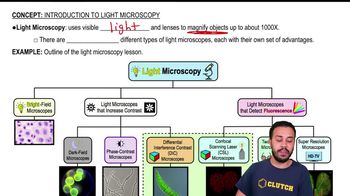
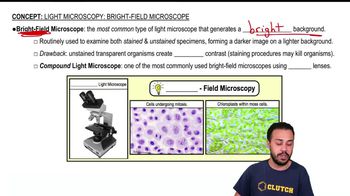
________ refers to differences in intensity between two objects.
Verified step by step guidance
1
Understand that the question is asking for a term related to visual differences in intensity between two objects, which is a concept often discussed in microscopy and microbiology imaging.
Recall that in microscopy, the term used to describe the difference in light intensity between two adjacent objects or areas is crucial for distinguishing details in a specimen.
Identify that this term is commonly known as 'contrast', which allows us to see differences in brightness or color that make structures visible under the microscope.
Recognize that contrast is essential for differentiating between cells, organelles, or microorganisms when viewing samples, especially when the objects have similar colors or transparency.
Conclude that the correct term to fill in the blank is 'contrast', as it specifically refers to differences in intensity between two objects.
Verified video answer for a similar problem:
This video solution was recommended by our tutors as helpful for the problem above
Video duration:
1m
Play a video:
0 Comments
Key Concepts
Here are the essential concepts you must grasp in order to answer the question correctly.
Contrast
Contrast in microbiology and microscopy refers to the difference in light intensity or color between two objects or areas, making it possible to distinguish structures in a specimen. Higher contrast improves visibility of details, especially in transparent or similarly colored samples.
Light intensity is the amount of light that illuminates or passes through a specimen. Variations in light intensity affect how clearly objects can be seen under a microscope, influencing the contrast and overall image quality.
Microscopy techniques, such as brightfield, phase contrast, and fluorescence microscopy, use different methods to enhance contrast between objects. Understanding these techniques helps explain how differences in intensity are manipulated to visualize microorganisms effectively.