Describe the five phases of a generalized lytic replication cycle.
Ch. 13 - Characterizing and Classifying Viruses, Viroids, and Prions
Bauman6th EditionMicrobiology with Diseases by TaxonomyISBN: 9780134832302Not the one you use?Change textbook
All textbooks
Bauman 6th Edition
Ch. 13 - Characterizing and Classifying Viruses, Viroids, and Prions
Problem 3
Bauman 6th Edition
Ch. 13 - Characterizing and Classifying Viruses, Viroids, and Prions
Problem 3Chapter 13, Problem 3
Why is it difficult to treat viral infections?
Verified step by step guidance1
Understand that viruses are intracellular parasites, meaning they replicate inside host cells, which makes targeting them without harming the host cells challenging.
Recognize that viruses use the host's cellular machinery for replication, so antiviral drugs must selectively inhibit viral processes without disrupting normal host cell functions.
Consider that viruses have fewer unique metabolic pathways compared to bacteria, limiting the number of viral-specific targets for drug development.
Acknowledge that viruses can rapidly mutate, leading to the development of drug resistance and making treatment more difficult.
Note that the immune system plays a crucial role in controlling viral infections, and antiviral treatments often aim to support or enhance immune responses rather than directly eliminate the virus.

Verified video answer for a similar problem:
This video solution was recommended by our tutors as helpful for the problem above.
Video duration:
2mWas this helpful?
Key Concepts
Here are the essential concepts you must grasp in order to answer the question correctly.
Viral Replication Inside Host Cells
Viruses replicate by invading and using the host's cellular machinery, making it challenging to target the virus without harming the host cells. Unlike bacteria, viruses are intracellular parasites, so treatments must distinguish between viral and host processes.
Recommended video:
Guided course
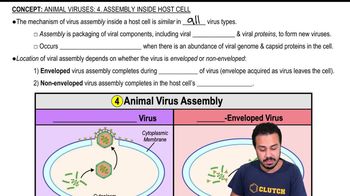
Animal Viruses: 4. Assembly Inside Host Cell
Lack of Metabolic Pathways in Viruses
Viruses lack their own metabolism and rely entirely on the host cell for energy and replication. This absence of independent metabolic pathways limits the number of viral-specific targets for antiviral drugs, unlike antibiotics that target bacterial metabolism.
Recommended video:
Guided course
Introduction to Metabolism
High Mutation Rates of Viruses
Many viruses, especially RNA viruses, mutate rapidly, leading to frequent changes in their genetic makeup. This high mutation rate can result in drug resistance and evasion of the immune system, complicating the development of effective and lasting antiviral treatments.
Recommended video:
Guided course
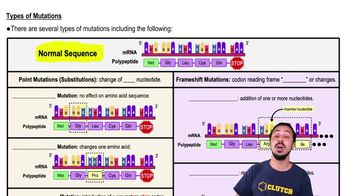
Types of Mutations
Related Practice
Textbook Question
1221
views
Textbook Question
Describe four different ways that viral nucleic acid can enter a host cell.
920
views
Textbook Question
Which of the following statements is true?
a. Viruses move toward their host cells.
b. Viruses are capable of metabolism.
c. Viruses lack a cytoplasmic membrane.
d. Viruses grow in response to their environmental conditions.
804
views
Textbook Question
A virus that is specific for a bacterial host is called a __________ .
a. Phage
b. Prion
c. Virion
d. Viroid
845
views
Textbook Question
A naked virus __________ .
a. Lacks a membranous envelope
b. Has injected its DNA or RNA into a host cell
c. Is devoid of capsomeres
d. Is one that is unattached to a host cell
1141
views
Textbook Question
Identify the viral capsid shapes.
a. ___________ <IMAGE>
b. ___________ <IMAGE>
c. ___________ <IMAGE>
d. ___________ <IMAGE>
717
views