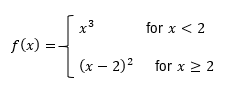
Determine if the graph of the function is continuous and/or differentiable at .
Table of contents
- 0. Functions4h 53m
- 1. Limits and Continuity2h 2m
- 2. Intro to Derivatives1h 33m
- 3. Techniques of Differentiation2h 18m
- 4. Derivatives of Exponential & Logarithmic Functions1h 16m
- 5. Applications of Derivatives2h 19m
- 6. Graphical Applications of Derivatives6h 0m
- 7. Antiderivatives & Indefinite Integrals48m
- 8. Definite Integrals4h 36m
- 9. Graphical Applications of Integrals1h 43m
- 10. Integrals of Inverse, Exponential, & Logarithmic Functions21m
- 11. Techniques of Integration2h 7m
- 12. Trigonometric Functions6h 54m
- Angles29m
- Trigonometric Functions on Right Triangles1h 8m
- Solving Right Triangles23m
- Trigonometric Functions on the Unit Circle1h 19m
- Graphs of Sine & Cosine46m
- Graphs of Other Trigonometric Functions32m
- Trigonometric Identities52m
- Derivatives of Trig Functions42m
- Integrals of Basic Trig Functions28m
- Integrals of Other Trig Functions10m
- 13: Intro to Differential Equations2h 23m
- 14. Sequences & Series2h 8m
- 15. Power Series2h 19m
- 16. Probability & Calculus45m
2. Intro to Derivatives
Differentiability
Multiple Choice
Determine if the functionf(x) is continuous and/or differentiable at x=2.

A
Continuous and non-differentiable
B
Continuous and differentiable
C
Discontinuous and non-differentiable
D
Discontinuous and differentiable
0 Comments
Verified step by step guidance1
Step 1: To determine if the function is continuous at x=2, check if the left-hand limit (as x approaches 2 from the left) equals the right-hand limit (as x approaches 2 from the right) and if both equal f(2). For x < 2, f(x) = x^3, and for x ≥ 2, f(x) = (x - 2)^2.
Step 2: Calculate the left-hand limit of f(x) as x approaches 2 from the left. Substitute x=2 into the expression x^3 to find the value of the limit.
Step 3: Calculate the right-hand limit of f(x) as x approaches 2 from the right. Substitute x=2 into the expression (x - 2)^2 to find the value of the limit.
Step 4: Compare the left-hand limit, right-hand limit, and f(2). If all three values are equal, the function is continuous at x=2. If not, the function is discontinuous at x=2.
Step 5: To determine differentiability at x=2, check if the derivative of f(x) from the left-hand side equals the derivative from the right-hand side at x=2. Compute the derivative of x^3 for x < 2 and the derivative of (x - 2)^2 for x ≥ 2, then evaluate both derivatives at x=2 and compare their values.
Related Videos
Related Practice
Multiple Choice