Solve each inequality. Give the solution set in interval notation. (4x+7)/-3≤2x+5
Verified step by step guidance
1
Start by writing down the inequality: \(\frac{4x+7}{-3} \leq 2x + 5\).
To eliminate the fraction, multiply both sides of the inequality by \(-3\). Remember, when multiplying or dividing an inequality by a negative number, you must reverse the inequality sign. So, multiplying both sides by \(-3\) gives: \(4x + 7 \geq -3(2x + 5)\).
Distribute the \(-3\) on the right side: \(4x + 7 \geq -6x - 15\).
Next, collect all the \(x\) terms on one side and constants on the other. Add \$6x\( to both sides and subtract \)7$ from both sides: \(4x + 6x \geq -15 - 7\), which simplifies to \(10x \geq -22\).
Finally, solve for \(x\) by dividing both sides by \$10$: \(x \geq \frac{-22}{10}\). Simplify the fraction if possible, then express the solution set in interval notation.
Verified video answer for a similar problem:
This video solution was recommended by our tutors as helpful for the problem above
Video duration:
5m
Play a video:
0 Comments
Key Concepts
Here are the essential concepts you must grasp in order to answer the question correctly.
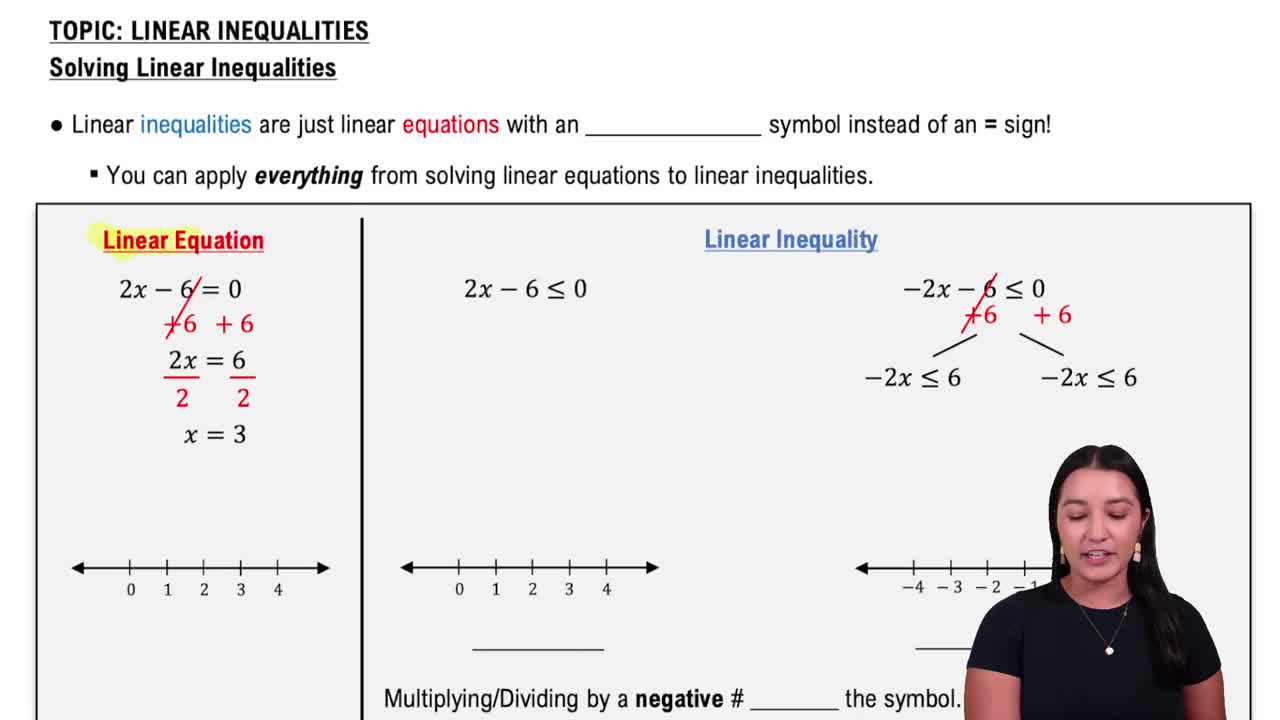
Solving Linear Inequalities
Solving linear inequalities involves isolating the variable on one side to find the range of values that satisfy the inequality. Similar to equations, operations like addition, subtraction, multiplication, and division are used, but special care is needed when multiplying or dividing by negative numbers, as this reverses the inequality sign.
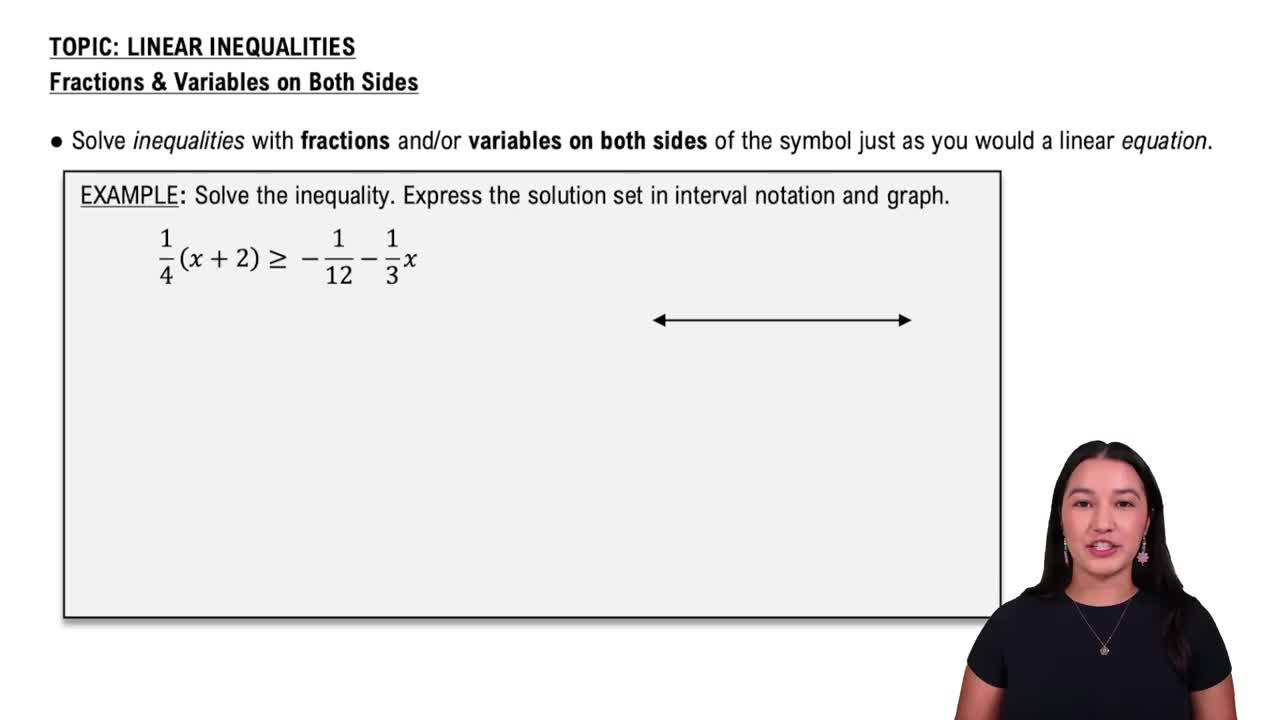
When inequalities include fractions, it is important to clear denominators by multiplying both sides by the least common denominator, ensuring the inequality direction is maintained or reversed appropriately. Simplifying fractions and combining like terms helps in isolating the variable effectively.
Linear Inequalities with Fractions & Variables on Both Sides
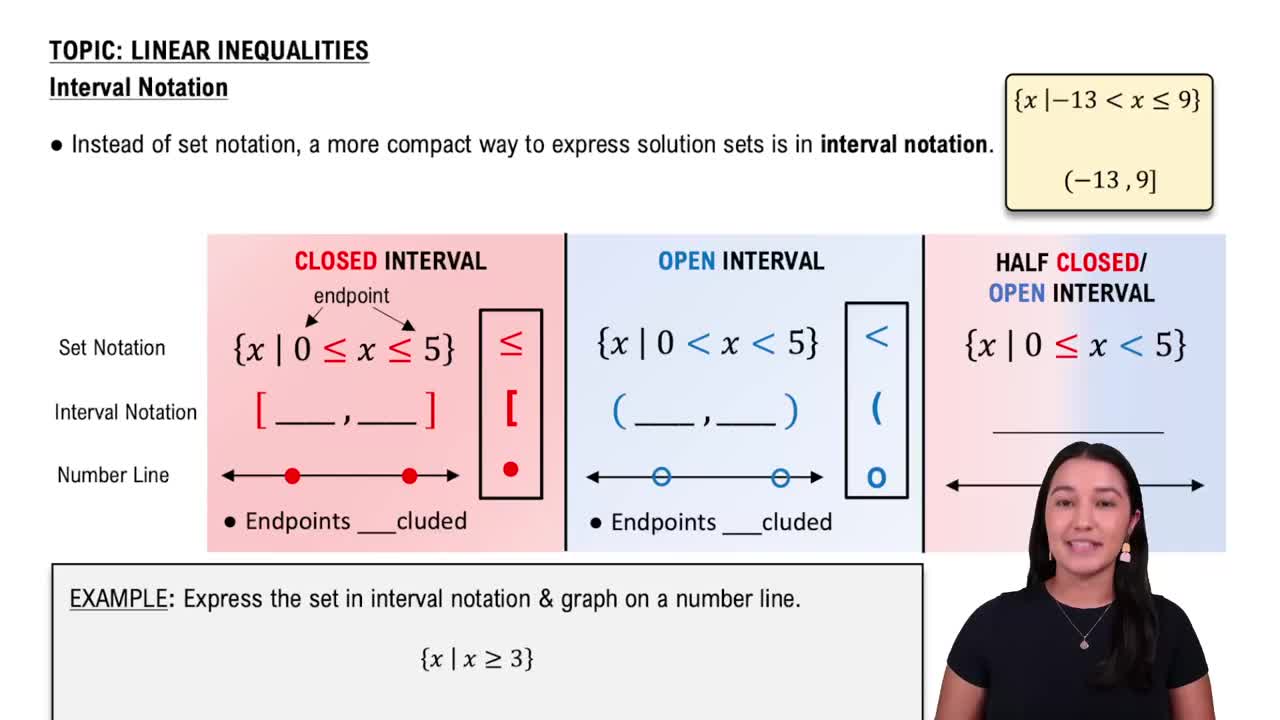
Interval Notation for Solution Sets
Interval notation expresses the solution set of inequalities using intervals on the number line. Parentheses indicate values not included (open intervals), while brackets indicate included values (closed intervals). This notation succinctly represents all values that satisfy the inequality.

 5:04 minutes
 Verified step by step guidance
 06:07
06:07