Ch.4 Skeletal System
Joints and Movements


Multiple Choice
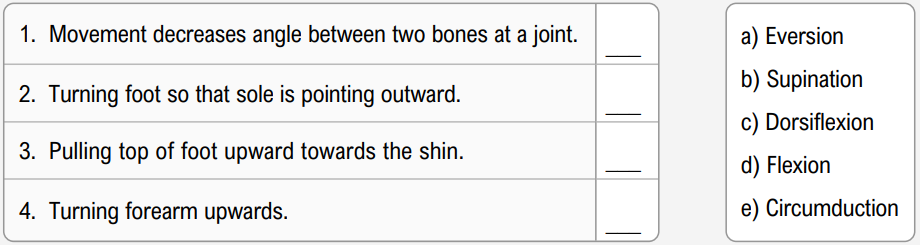
Match each description with the correct joint movement.
A
1. d
2. a
3. c
4. b
B
1. d
2. e
3. b
4. c
C
1. a
2. c
3. d
4. b
D
1. a
2. b
3. c
4. e
 Verified step by step guidance
1
Step 1: Understand the meaning of each description. The first description is 'Movement decreases angle between two bones at a joint.' This refers to a movement that reduces the angle, which is typically called 'Flexion.'
Step 2: For the second description, 'Turning foot so that sole is pointing outward,' identify the movement that involves rotating the sole of the foot outward. This is known as 'Eversion.'
Step 3: The third description, 'Pulling top of foot upward towards the shin,' describes a movement where the foot is flexed upwards. This movement is called 'Dorsiflexion.'
Step 4: The fourth description, 'Turning forearm upwards,' refers to rotating the forearm so the palm faces up or forward, which is called 'Supination.'
Step 5: Match each description with the correct term based on the above understanding: 1 - Flexion (d), 2 - Eversion (a), 3 - Dorsiflexion (c), 4 - Supination (b).


Related Videos
0