Graph the functions in Exercises 9 and 10. Then answer these questions.
f(x) = {x,−1 ≤ x < 0, or 0 < x ≤ 1 1, x = 0 0, x < −1 or x > 1
d. At what points does the right-hand limit exist but not the left-hand limit?
Verified step by step guidance
1
First, understand the piecewise function given: f(x) = {x, for −1 ≤ x < 0 or 0 < x ≤ 1; 1, for x = 0; 0, for x < −1 or x > 1}. This function has different expressions depending on the interval of x.
Graph the function by plotting each piece separately. For −1 ≤ x < 0, plot f(x) = x, which is a line segment from (-1, -1) to (0, 0) excluding the endpoint at x = 0. For 0 < x ≤ 1, plot f(x) = x, which is a line segment from (0, 0) to (1, 1) including the endpoint at x = 1.
At x = 0, plot the point (0, 1) since f(x) = 1 when x = 0. This is a discrete point on the graph.
For x < -1 and x > 1, plot f(x) = 0, which are horizontal lines extending to the left of x = -1 and to the right of x = 1.
To determine where the right-hand limit exists but not the left-hand limit, examine the graph at the endpoints of each interval. Specifically, check the behavior of the function as x approaches 0 from the right and from the left. The right-hand limit exists at x = 0, but the left-hand limit does not because the function jumps from 0 to 1.
Verified video answer for a similar problem:

This video solution was recommended by our tutors as helpful for the problem above
Video duration:
6m
Play a video:
0 Comments
Key Concepts
Here are the essential concepts you must grasp in order to answer the question correctly.
Limits
In calculus, a limit is the value that a function approaches as the input approaches some value. Limits are essential for defining derivatives and integrals. Understanding limits involves analyzing the behavior of a function as it gets arbitrarily close to a particular point, which can be done graphically or algebraically.
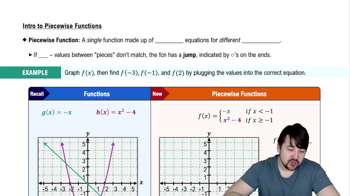
A piecewise function is defined by different expressions for different intervals of the domain. Understanding how to interpret and graph piecewise functions is crucial, as it involves analyzing each segment separately and considering the behavior at the boundaries, which is essential for determining limits and continuity.
One-sided limits refer to the value a function approaches as the input approaches a specific point from one side—either from the left (left-hand limit) or the right (right-hand limit). These are particularly useful for analyzing discontinuities and understanding the behavior of piecewise functions at boundary points.