Step 1: Recognize that the function y = 2x^{\sqrt{2}} is in the form of a power function, where the exponent is an irrational number, \sqrt{2}.
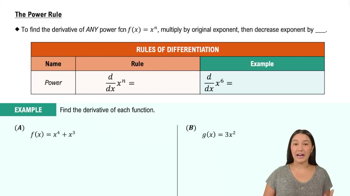
Step 2: To differentiate y with respect to x, use the power rule for differentiation, which states that if y = x^n, then y' = n \cdot x^{n-1}.
Step 3: Apply the power rule to the given function. Here, n = \sqrt{2}, so the derivative y' = \sqrt{2} \cdot 2x^{\sqrt{2} - 1}.
Step 4: Simplify the expression for y' by multiplying the constant \sqrt{2} with 2, resulting in y' = 2\sqrt{2} \cdot x^{\sqrt{2} - 1}.
Step 5: The expression y' = 2\sqrt{2} \cdot x^{\sqrt{2} - 1} is the simplified form of the derivative of the given function.
Verified video answer for a similar problem:
This video solution was recommended by our tutors as helpful for the problem above
Video duration:
2m
Play a video:
0 Comments
Key Concepts
Here are the essential concepts you must grasp in order to answer the question correctly.
Differentiation
Differentiation is a fundamental concept in calculus that involves finding the derivative of a function. The derivative represents the rate of change of the function with respect to its variable. In this case, we need to differentiate the function y = 2x^(√2) to find y'.
The Power Rule is a basic rule for differentiation that states if y = x^n, then the derivative y' = n*x^(n-1). This rule simplifies the process of finding derivatives for polynomial and power functions, making it essential for evaluating y' in the given function.
The Constant Multiple Rule states that if a function is multiplied by a constant, the derivative of the function is the constant multiplied by the derivative of the function itself. In this case, since y = 2x^(√2), we will apply this rule to factor out the constant 2 when differentiating.