Evaluating inverse trigonometric functions Without using a calculator, evaluate the following expressions. tan−1(tan(4π))
Verified step by step guidance
1
Understand the problem: We need to evaluate \( \tan^{-1}(\tan(\frac{\pi}{4})) \). This involves understanding the properties of the inverse trigonometric functions.
Recall the definition of the inverse tangent function: \( \tan^{-1}(x) \) is the angle \( \theta \) such that \( \tan(\theta) = x \) and \( \theta \) is in the interval \( (-\frac{\pi}{2}, \frac{\pi}{2}) \).
Evaluate \( \tan(\frac{\pi}{4}) \): The tangent of \( \frac{\pi}{4} \) is 1, because \( \tan(\theta) = \frac{\sin(\theta)}{\cos(\theta)} \) and both \( \sin(\frac{\pi}{4}) \) and \( \cos(\frac{\pi}{4}) \) are \( \frac{\sqrt{2}}{2} \).
Apply the inverse function: Since \( \tan(\frac{\pi}{4}) = 1 \), we have \( \tan^{-1}(1) \). The angle whose tangent is 1 and lies within \( (-\frac{\pi}{2}, \frac{\pi}{2}) \) is \( \frac{\pi}{4} \).
Conclude the evaluation: Therefore, \( \tan^{-1}(\tan(\frac{\pi}{4})) = \frac{\pi}{4} \).
Verified video answer for a similar problem:
This video solution was recommended by our tutors as helpful for the problem above
Video duration:
2m
Play a video:
0 Comments
Key Concepts
Here are the essential concepts you must grasp in order to answer the question correctly.
Inverse Trigonometric Functions
Inverse trigonometric functions, such as an^{-1} (arctan), are used to find the angle whose tangent is a given number. They essentially reverse the action of the trigonometric functions. For example, an^{-1}(x) gives the angle θ such that tan(θ) = x. Understanding these functions is crucial for evaluating expressions involving them.
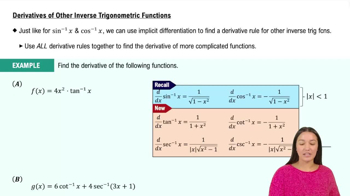
Derivatives of Other Inverse Trigonometric Functions
Properties of the Tangent Function
The tangent function, defined as the ratio of the opposite side to the adjacent side in a right triangle, is periodic with a period of π. This means that tan(θ) = tan(θ + nπ) for any integer n. This periodicity is important when evaluating expressions like an^{-1}( an(x)), as it helps determine the correct angle within the principal range of the inverse function.
The principal value of an inverse trigonometric function is the unique output value that lies within a specified range. For an^{-1}(x), the principal value is restricted to the interval (-π/2, π/2). This restriction ensures that each input corresponds to exactly one output, which is essential for correctly evaluating expressions involving inverse functions.


 2:19 minutes
 Verified step by step guidance
 06:35
06:35