

Average value with a parameter Consider the function Ζ(π) = aπ (1βπ) on the interval [0, 1], where a is a positive real number. (a) Find the average value of Ζ as a function of a .
Verified step by step guidance
1
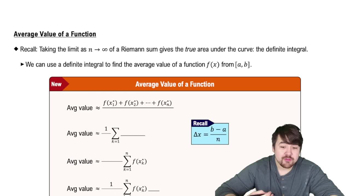
Step 1: Recall the formula for the average value of a function Ζ(π) on the interval [a, b], which is given by: . In this case, the interval is [0, 1] and the function is Ζ(π) = aπ(1 - π).
Step 2: Substitute the interval [0, 1] and the function Ζ(π) = aπ(1 - π) into the formula for average value: . This simplifies to: .
Step 3: Expand the integrand aπ(1 - π) to simplify the integral. This becomes: . The integral now looks like: .
Step 4: Break the integral into two separate parts: . Compute each integral separately: and . Use the power rule for integration: .
Step 5: After computing the integrals, combine the results and multiply by the constant 'a' to find the average value of Ζ(π) as a function of 'a'. The final expression will represent the average value of the function over the interval [0, 1].
Verified video answer for a similar problem:
This video solution was recommended by our tutors as helpful for the problem above
Video duration:
3m
Play a video:
0 Comments
Key Concepts
Here are the essential concepts you must grasp in order to answer the question correctly.
Average Value of a Function
The average value of a continuous function Ζ over an interval [a, b] is calculated using the formula (1/(b-a)) * β«[a to b] Ζ(x) dx. This concept is essential for determining how the function behaves on the specified interval, providing a single representative value that summarizes the function's overall trend.
A definite integral represents the accumulation of quantities, such as area under a curve, over a specific interval. In this context, it is used to compute the integral of the function Ζ(x) = aπ(1 - π) from 0 to 1, which is necessary for finding the average value of the function.
A parameter is a variable that influences the behavior of a function but is not the primary variable of interest. In this case, 'a' is a parameter that affects the shape and scale of the function Ζ(x) = aπ(1 - π), and understanding its role is crucial for expressing the average value as a function of 'a'.