In Exercises 83–88, find equations for the lines that are tangent, and the lines that are normal, to the curve at the given point. __ x + √xy = 6, (4, 1)
Verified step by step guidance
1
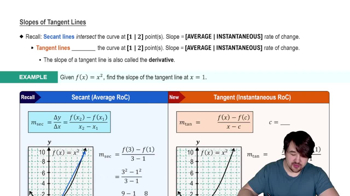
First, understand that the problem requires finding the tangent and normal lines to the curve given by the equation \(x + \sqrt{xy} = 6\) at the point (4, 1). The tangent line is the line that just touches the curve at this point, while the normal line is perpendicular to the tangent line at this point.
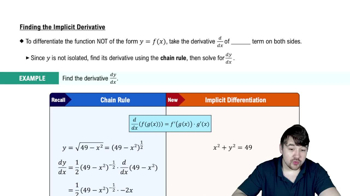
To find the equation of the tangent line, we need to determine the derivative of the curve with respect to x, which will give us the slope of the tangent line at the point (4, 1). Start by differentiating both sides of the equation \(x + \sqrt{xy} = 6\) with respect to x. Use implicit differentiation since y is a function of x.
Differentiate the left side: The derivative of \(x\) is 1. For \(\sqrt{xy}\), use the chain rule: \(\frac{d}{dx}(\sqrt{xy}) = \frac{1}{2\sqrt{xy}} \cdot (y + x \frac{dy}{dx})\). Set the derivative of the right side, which is a constant, to 0.
Solve the resulting equation for \(\frac{dy}{dx}\) to find the slope of the tangent line at the point (4, 1). Substitute x = 4 and y = 1 into the derivative to find the specific slope at this point.
Once you have the slope of the tangent line, use the point-slope form of a line equation, \(y - y_1 = m(x - x_1)\), where m is the slope and (x_1, y_1) is the point (4, 1), to write the equation of the tangent line. For the normal line, use the negative reciprocal of the tangent slope as the slope of the normal line, and apply the point-slope form again to find its equation.
Verified video answer for a similar problem:
This video solution was recommended by our tutors as helpful for the problem above
Video duration:
5m
Play a video:
Was this helpful?
Key Concepts
Here are the essential concepts you must grasp in order to answer the question correctly.
Implicit Differentiation
Implicit differentiation is a technique used to differentiate equations where the dependent and independent variables are not explicitly separated. In this case, we differentiate both sides of the equation with respect to x, treating y as a function of x. This allows us to find dy/dx, which is essential for determining the slope of the tangent line at a specific point.
A tangent line to a curve at a given point is a straight line that touches the curve at that point without crossing it. The slope of the tangent line is equal to the derivative of the function at that point. To find the equation of the tangent line, we use the point-slope form of a line, which requires the slope and the coordinates of the point of tangency.
The normal line to a curve at a given point is perpendicular to the tangent line at that point. Its slope is the negative reciprocal of the slope of the tangent line. To find the equation of the normal line, we again use the point-slope form, substituting the coordinates of the point and the calculated slope of the normal line.